

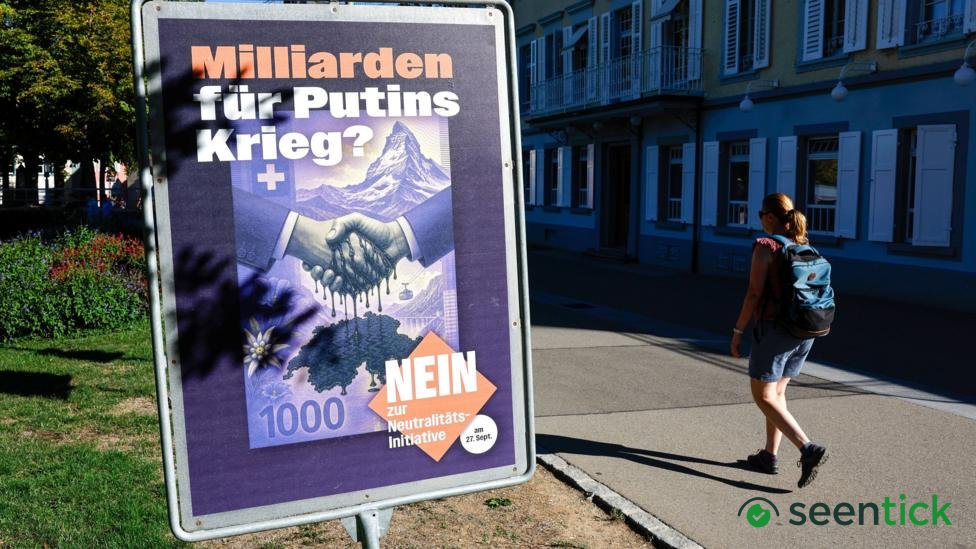
Switzerland Rejects Stricter Neutrality Proposal, Backs Sanctions Against Russia
Key Highlights
- Switzerland rejects stricter neutrality proposal.
- Over 70% of voters reject move.
- Switzerland backs sanctions against Russia.
- Russia's invasion of Ukraine sparks debate on Switzerland's neutrality.
Switzerland's voters have overwhelmingly rejected a proposal to strengthen the country's diplomatic neutrality, with over 70% of voters rejecting the move. The decision comes as Russia's full-scale invasion of Ukraine has reopened the debate around Switzerland's centuries-old non-alignment. This is not the first time Switzerland's neutrality has been put to the test, however.
During World War Two, Switzerland's diplomatic neutrality was a subject of international scrutiny, with Nazi Germany seeking to exploit the country's strategic location.
Switzerland's commitment to neutrality has been a cornerstone of its foreign policy since the 19th century. The country's neutrality has been formally enshrined in the Hague Convention of 1907. Which forbade Switzerland from supplying weapons to countries at war.
Read More: Trump's White Genocide Claim Sparks Controversy as South Africa's New Ambassador Challenges Reality
However, the country's system of direct democracy means that major political decisions are often deferred to the voters through referendums, as seen in the recent rejection of the stricter neutrality proposal. This tradition reflects the Swiss people's desire to shape their foreign policy through direct participation.
Despite rejecting the stricter neutrality proposal, Switzerland has announced plans to impose sanctions on Russia in response to its actions in Ukraine. The country's government has also pledged to support Ukraine in its efforts to defend itself against Russian aggression.
This decision is seen as a demonstration of Switzerland's willingness to take action against Russia, while still upholding its commitment to neutrality. As Lukas Golder, co-director of research institute Gfs.bern, noted, "neutrality does not mean indifference" – a sentiment echoed by Swiss Foreign Minister Ignazio Cassis, who stated that the vote showed Switzerland's commitment to its neutrality, but also its willingness to take action against Russia.
Also Read: Dangote to Fund $660m Ethiopia-Djibouti Fuel Pipeline
Switzerland's recognition of its neutrality dates back to 1815, when the country was granted "eternal neutrality" at the Congress of Vienna. This recognition was a response to the tumultuous period of war and upheaval in Europe at the time. Today, Switzerland's neutrality remains a cornerstone of its foreign policy.
However, the recent vote suggests that the country is willing to adapt its approach in response to changing global circumstances.
While the rejection of the stricter neutrality proposal may seem like a minor setback for Switzerland's commitment to neutrality, it is clear that the country's voters are willing to take a stand against Russia's actions in Ukraine. As the international community continues to grapple with the implications of Russia's invasion, Switzerland's decision serves as a reminder of the importance of adaptability and flexibility in foreign policy.
What's Your Reaction?
 Like
Like
 Dislike
 Love
Love
 Funny
Funny
 Wow
2
Wow
2
 Sad
Sad
 Angry
2
Angry
2

I write about the forces shaping business and the global economy, from startup growth and changing markets to international trade and policy. My work focuses on breaking down complex developments into clear, practical insights and understanding what they could mean for businesses, investors, and the wider economy.









Comments (0)