

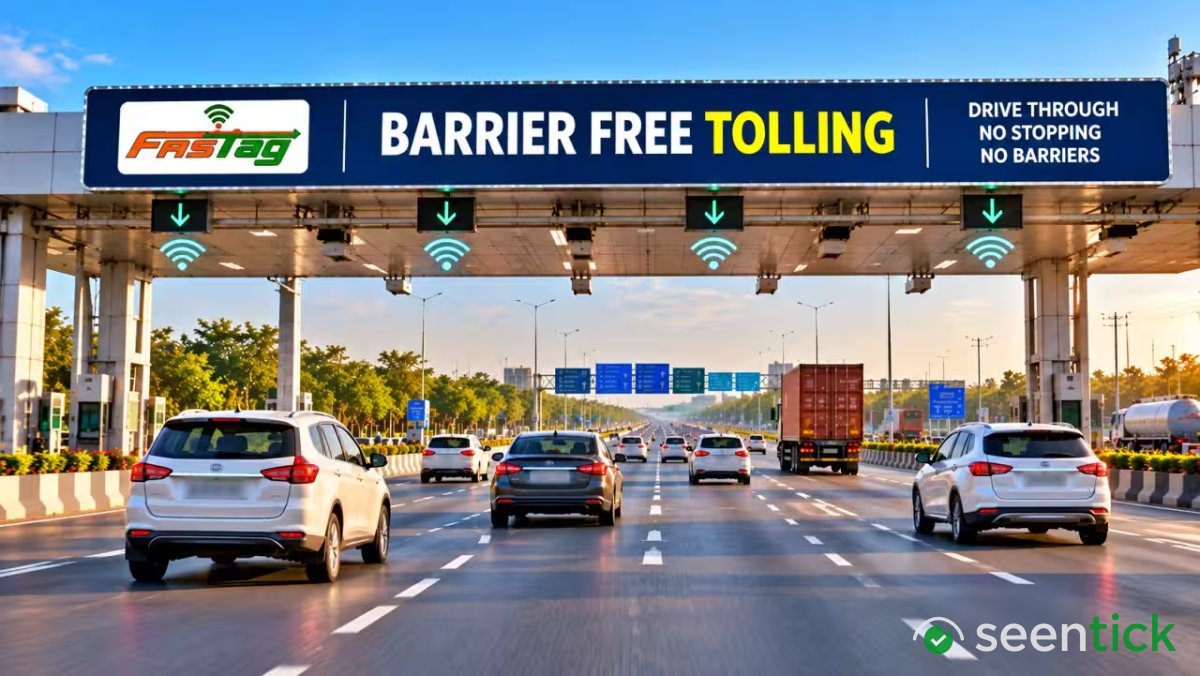
India Rolls Out Barrier-Free Tolling System on National Highways
Key Highlights
- India rolls out barrier-free tolling system on national highways.
- System reduces travel time and congestion.
- Government aims to save Rs 5,000-6,000 crore a year.
The Indian government has launched a nationwide barrier-free tolling system on national highways, aiming to reduce travel time, congestion, and fuel consumption. The system, which has been rolled out in several sections of the country, is expected to save the government around Rs 5,000-6,000 crore annually.
The rollout of the new system began in May this year at the Chorayasi Toll Plaza on the Surat-Bharuch section of NH-48 in Gujarat. Since then, several other sections of national highways have seen the implementation of the new Multi-Lane Free Flow (MLFF) system. The government has also introduced a FASTag-based Annual Pass for non-commercial cars.
This allows them to travel through National Highway and National Expressway fee plazas for a year or up to 200 crossings, whichever comes first.
Read More: Trump Announces Largest Oil Deal in History, Promising Lower Energy Costs
According to the Economic Survey 2025-26, the government aims to make toll booths on national highways barrier-free by March 2027. Over 70% of toll booths will have the MLFF system by December end, as announced by Road Transport and Highways minister Nitin Gadkari. The system will be implemented using Automatic Number Plate Recognition (ANPR) technology.
This will identify vehicles and collect toll automatically, eliminating the need for physical barriers.
The introduction of barrier-free tolling is part of the government's efforts to improve the overall efficiency of the transportation sector. The system is expected to reduce human intervention in toll operations, making it more efficient and convenient for drivers.
With the new system, the government aims to improve fuel efficiency, lower vehicular emissions, and provide a better driving experience for citizens.
According to Deloitte India, the biggest benefit of barrier-less plazas will be smoother traffic movement. Vehicles will no longer need to slow down. Pause, or queue at toll plazas, resulting in reduced travel time, fuel consumption, and congestion, particularly on busy highway stretches.
Also Read: Trump Announces Belarusian Potash Deal Amid India Energy Spat
The rollout of the barrier-free tolling system is a significant step towards improving the efficiency of the transportation sector in India. The system is expected to have a positive impact on the country's transportation infrastructure, reducing congestion, fuel consumption, and emissions. Meanwhile, providing a better experience for drivers.
The government has set a timeline for the rollout of the new system. With several sections already seeing the implementation of the MLFF system. The government has also established a dedicated hotline for drivers to report any issues or concerns related to the new system.
The barrier-free tolling system is expected to have several benefits. This includes reduced travel time, improved fuel efficiency, lower vehicular emissions, and reduced human intervention in toll operations. The system is also expected to promote smoother traffic movement, reducing congestion and fuel consumption on busy highway stretches.
What's Your Reaction?
 Like
1
Like
1
 Dislike
 Love
Love
 Funny
Funny
 Wow
2
Wow
2
 Sad
Sad
 Angry
1
Angry
1

I write about the forces shaping business and the global economy, from startup growth and changing markets to international trade and policy. My work focuses on breaking down complex developments into clear, practical insights and understanding what they could mean for businesses, investors, and the wider economy.













Comments (0)