

Sold home jointly owned with wife? You can claim 100% LTCG
Sold home jointly owned with wife? You can claim 100% LTCG
Key Highlights
- You bought a property jointly in the name of yourself and your wife, but the entire money spent on the purchase came from you.
- Now you are planning to sell it and are wondering whether the new property that you plan to purchase for long-term capital gains (LTCG) exemption, should also be jointly owned Itâs an interesting question, and one that has income tax implications, so you need to be careful.The most important point to note in this matter is the proof of the financing for the first property.
- If you have a clear trail and adequate documentation that can establish the money to buy the first property was entirely yours, then the new property need not be purchased in joint names.Joint property sale & LTCG exemptionShubham Agrawal, Senior Taxation Adviser, TaxFile.in recently told ET that if an individual alone financed the entire joint property purchase, then he would be considered the 100% beneficial owner.
Purchasing a second home for long-term capital gains (LTCG) exemption can be a complex process, especially when it comes to joint ownership of the first property.
If you financed the entire purchase of your jointly owned property with your own funds, you are considered the 100% beneficial owner. In this case, the next property purchased through reinvestment can be registered solely in your name, eliminating the need for joint ownership.
However, if you're unsure about whether to purchase a second home jointly or not, it's essential to consider the implications of selling the first property and claiming LTCG exemption benefits. When selling a jointly owned property, ensure that the buyer deducts the full TDS against your PAN alone.
Read More: Middle East’s Energy Leaders Up Investments In Natural Gas Resilience
Additionally, report the entire sale proceeds and resulting capital gain in your income tax return.
To establish that the original investment was funded entirely This can help prevent any discrepancies or notices from the income tax portal. If the property sale appears on your wife's AIS, she should provide feedback stating that the transaction relates to another PAN or family member to avoid receiving a notice.
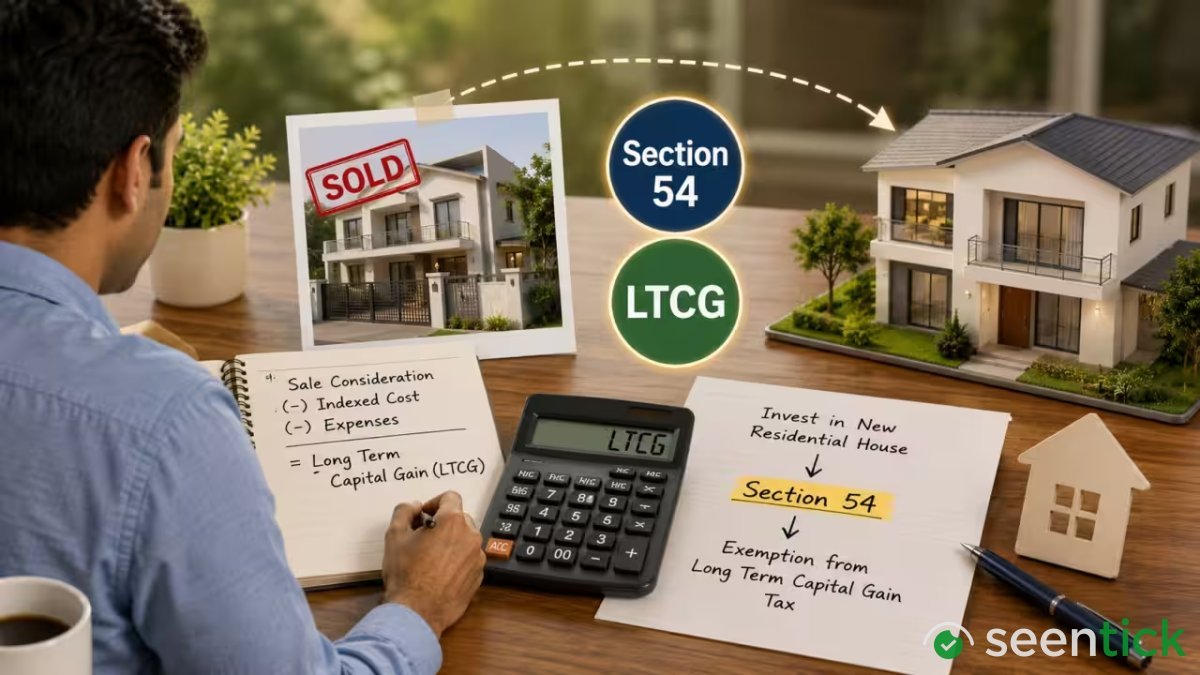
For those eligible for LTCG exemption under Section 54, it provides relief from long-term capital gains tax when selling a residential house and reinvesting the capital gain in another residential house in India. The exemption is available only to individuals or HUFs, and the property must be a long-term capital asset and a residential house property.
The replacement house must meet specific time limits, including purchasing within one year before or two years after selling the old property, or constructing within three years from the date of transfer. The exemption is restricted to the lower of the capital gain or the amount invested in the new residential house.
There's also a special provision allowing investment in two residential houses where the long-term capital gain does not exceed Rs 2 crore.
It's essential to note that there's a Rs 10 crore ceiling for the exemption, and if the cost of the new residential property exceeds this amount, only up to Rs 10 crore can qualify for the LTCG exemption. Additionally, if you have not bought the new house within the specified timeframe, you can claim the exemption while getting additional time to purchase or construct the replacement property.
Lastly, be aware that Section 54 comes with a lock-in condition, and if the new house is sold within three years of purchase or completion, the earlier exemption is effectively withdrawn. The amount of capital gain that was exempt is deducted from the cost of the new house when calculating its capital gain, ensuring that the exemption is not lost later on.
What's Your Reaction?
 Like
Like
 Dislike
 Love
Love
 Funny
Funny
 Wow
2
Wow
2
 Sad
Sad
 Angry
2
Angry
2

I write about the forces shaping business and the global economy, from startup growth and changing markets to international trade and policy. My work focuses on breaking down complex developments into clear, practical insights and understanding what they could mean for businesses, investors, and the wider economy.















Comments (0)