

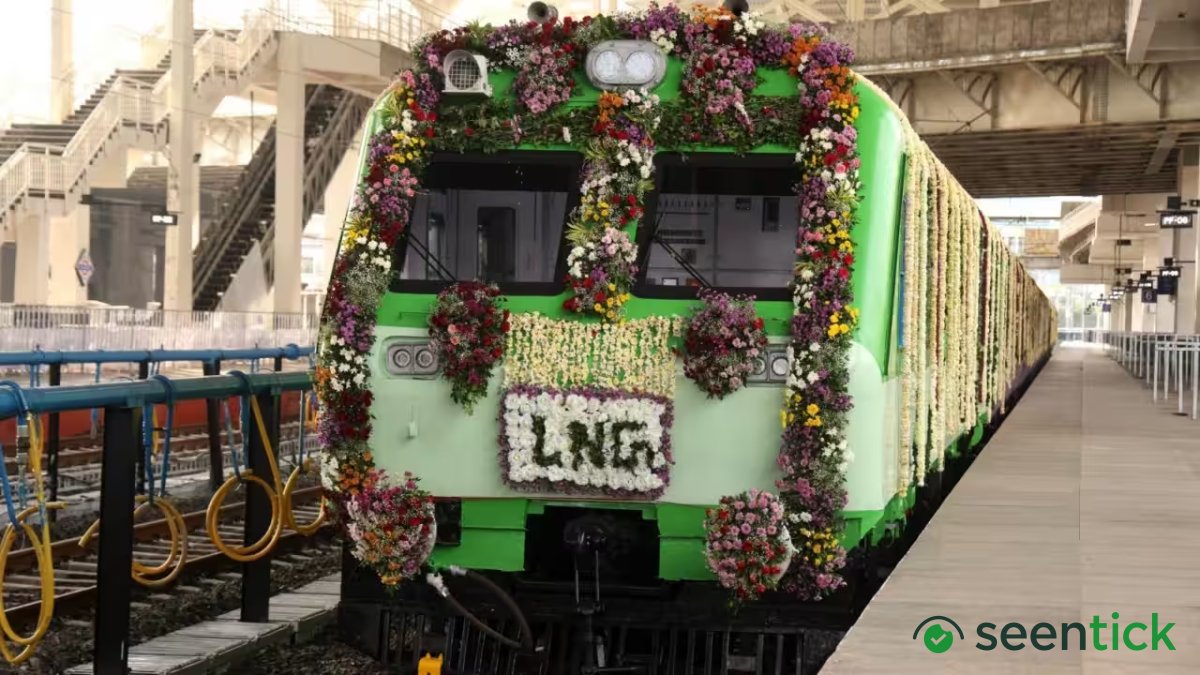
India Rolls Out First LNG-Powered Train as Railways Pushes for Sustainable Transport
Key Highlights
- Indian Railways has rolled out its first LNG-powered train.
- The train operates on a dual-fuel diesel-plus-LNG system.
- The technology could lower fuel costs and emissions.
Indian Railways has flagged off its first LNG-powered train. This marked a significant step towards reducing carbon emissions and moving towards more sustainable modes of transport.
Home Minister Amit Shah, who attended the event, said the LNG-powered train will make a significant contribution to environmental conservation in the years to come.
The LNG-powered train operates on a dual-fuel diesel-plus-LNG system developed for its Driving Power Cars (DPCs). At the Sabarmati Integrated Coaching Depot, two DPCs, each with a power capacity of 1,400 HP, have been modified to operate using the dual-fuel technology.
Read More: Sensex's 2-Year Drought: What's Behind India's Slowing Stock Market
The system allows the locomotives to use LNG along with diesel.
According to trial data released by the Railways, the technology could lower fuel costs as well as emissions. This includes carbon dioxide, nitrogen oxides, and particulate matter. The two converted DPCs have undergone more than 2,000 km of field trials to evaluate the technology's performance and reliability under operating conditions.
Home Minister Amit Shah also highlighted several infrastructure and operational changes. He said 97% of bio-toilets had been installed in trains under the Modi government. Meanwhile, 87% of LBH coaches produced during the Prime Minister's tenure were manufactured in India.
Railway electrification increased by 70%, the budget allocated for railway safety rose by 67%, and locomotive production capacity expanded by 66% during Modi's tenure.
Also Read: CEA Flags India's Economic Growth Over 'Uneasy Equilibrium'
"Modi solidified the concept of Make in India, the concept of self-reliant India, and this is the result of it. In 2015-16, Railways used 293 crore litres of diesel. By 2024-25 it will be 108 crore litres, and by 2030 it will be reduced to zero.
We will save currency. This is a great achievement which does not come to people's attention," Shah said.
The annual addition of electrified railway tracks had risen from 75 km in 2010-11 to 7,188 km in 2023-24.
What's Your Reaction?
 Like
Like
 Dislike
 Love
1
Love
1
 Funny
Funny
 Wow
3
Wow
3
 Sad
Sad
 Angry
Angry

I write about the forces shaping business and the global economy, from startup growth and changing markets to international trade and policy. My work focuses on breaking down complex developments into clear, practical insights and understanding what they could mean for businesses, investors, and the wider economy.









Comments (0)