

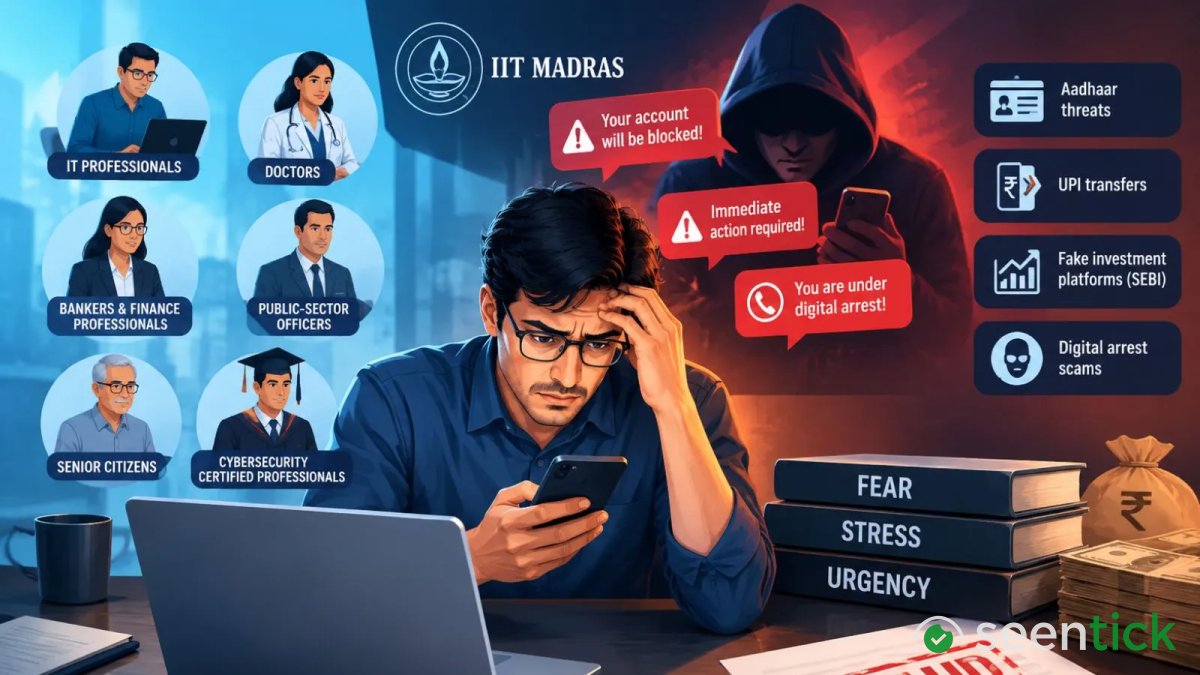
Cyber Fraudsters Exploit Fear, Stress to Impair Decision-Making
Key Highlights
- IIT Madras study finds victims targeted during periods of heightened vulnerability.
- Victims reported financial losses ranging from Rs 1 lakh to over Rs 1 crore.
- Experts call for stronger systems for early detection and coordinated response.
Despite their digital acumen, even the most erudite individuals can be duped by sophisticated financial cyber scams, which prey on the cognitive biases of their targets. Research by the Indian Institute of Technology's Madras campus has revealed a telling pattern: scammers tend to target IT specialists.
Bankers, and medical professionals, who possess unique expertise that can be leveraged to their advantage.
The study, which interviewed 33 victims, found that those targeted included a diverse range of professionals and individuals, with 22 men and 11 women. This includes 12 senior citizens, across various cities in India.
Read More: Uttar Pradesh's Sugar Output Plummets Amid Red Rot Crisis
Researchers discovered that victims were often targeted during periods of heightened vulnerability. Such as when they were ill, retired, or experiencing job pressure. The financial losses reported by victims ranged from a few thousand rupees to over Rs 1 crore.
With consequences extending beyond monetary losses to include feelings of shame, insomnia, depression, and strained family relationships.
Experts emphasize the need for stronger systems to detect and respond to financial cybercrime. Professor P Kandaswamy, a retired Indian Police Service officer, notes that responses must move beyond blaming victims and instead focus on providing better support and coordination.
Indian authorities have uncovered a range of sophisticated fraud schemes tailored to the country's unique digital landscape. Leveraging Aadhaar and UPI-based transactions, as well as fake investment platforms and 'digital arrest' scams. The response from institutions has been inconsistent, with some banks and cybercrime units swiftly addressing the issue.
Also Read: Poland's PM Donald Tusk to Visit India Next Month, Bolstering Economic, Political Ties
Meanwhile, others struggle with inadequate technical resources and coordination.
Professor Sudarsanam of the Wadhwani School highlights the importance of understanding the factors that make individuals vulnerable to financial cybercrime. Even those with high digital literacy. He emphasizes the need for effective prevention strategies that take into account the psychological and emotional aspects of these crimes.
The researchers plan to conduct a multilingual. Large-scale survey to test their findings and expand their research to tier-II and tier-III cities, the unorganized sector, and long-term victim recovery.
What's Your Reaction?
 Like
1
Like
1
 Dislike
 Love
1
Love
1
 Funny
Funny
 Wow
Wow
 Sad
1
Sad
1
 Angry
1
Angry
1

Tech journalist and AI enthusiast who enjoys keeping up with the latest in hardware, processors, emerging AI tools, and software. I like digging into new technology, understanding how things actually work, and following the developments that could shape the way we use technology in the future.













Comments (0)