

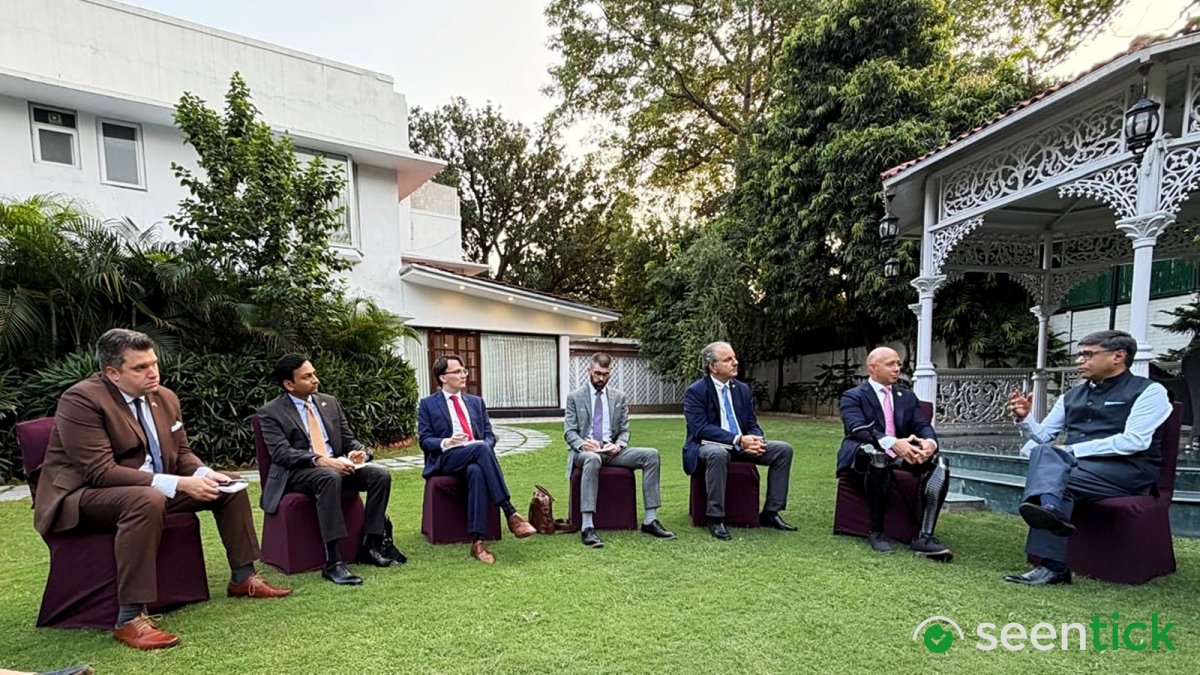
India Engages US Congress on Russia Sanctions Act, Energy Ties Gain Momentum
Key Highlights
- India meets US Congress on Russia sanctions Act.
- Energy ties gain momentum between India and US.
- India-US bilateral cooperation on energy security.
Foreign Secretary Vikram Misri met with a bipartisan US Congressional delegation led by Representative Brian Mast. Chairman of the House Foreign Affairs Committee, on Sunday. The meeting took place amidst discussions over the new Russia sanctions legislation.
This comes days after External Affairs Minister S Jaishankar met his US counterpart Marco Rubio and conveyed concerns over the Sanctioning Russia and Iran Act.
The meeting provided an opportunity for both sides to discuss bilateral cooperation, including energy security, and regional issues. The discussions also touched upon India's energy needs. With the country relying on imports to meet over 88% of its crude oil requirements.
Russia currently accounts for nearly half of these imports, a trend that has sparked concerns about diversification of energy sources.
Read More: Uttar Pradesh's Sugar Output Plummets Amid Red Rot Crisis
India's reliance on Russian energy imports has significant implications for the country's energy security. With Russia accounting for nearly half of India's crude oil imports, the country is vulnerable to disruptions in supply. This has led to discussions about diversifying energy sources, with the government exploring alternative partners to reduce dependence on Russia.
The new legislation proposes a mechanism that could lead to tariffs of up to 100% on imports from countries that continue purchasing Russian energy. However, the legislation does not automatically impose a 100% tariff on Indian goods, which has sparked concerns about potential trade implications.
Discussions between India and the US covered a range of topics. This includes the recently enacted SRIA legislation and the future trajectory of the relationship. The two sides also exchanged views on international issues of mutual concern, including energy security, counter-terrorism, and freedom of navigation.
Indian Foreign Minister S Jaishankar also met with Under Secretary of State for Economic Affairs Jacob Helberg in New York. There, they agreed to advance India-US cooperation in critical and emerging technologies. This includes through initiatives like Pax Silica.
They also strengthened cooperation in semiconductors and critical minerals.
Also Read: Poland's PM Donald Tusk to Visit India Next Month, Bolstering Economic, Political Ties
Jaishankar's discussions with US Senator Marco Rubio focused on India's economic and strategic reservations regarding the proposed legislation targeting Russian energy buyers. Rubio acknowledged that sanctions could be applied to countries trading with Russia and Iran, while expressing US support for regional energy security.
These meetings demonstrate the importance of India-US bilateral cooperation on energy security, a critical aspect of the relationship. As the global energy landscape continues to evolve, India and the US must work together to address emerging challenges and opportunities.
Jaishankar's meetings with US officials have highlighted the need for greater cooperation on energy security, a key aspect of the India-US relationship. The two countries must work together to address the implications of the new sanctions legislation and promote a more stable and secure energy future.
What's Your Reaction?
 Like
3
Like
3
 Dislike
 Love
Love
 Funny
Funny
 Wow
2
Wow
2
 Sad
Sad
 Angry
Angry

Tech journalist and AI enthusiast who enjoys keeping up with the latest in hardware, processors, emerging AI tools, and software. I like digging into new technology, understanding how things actually work, and following the developments that could shape the way we use technology in the future.









Comments (0)