

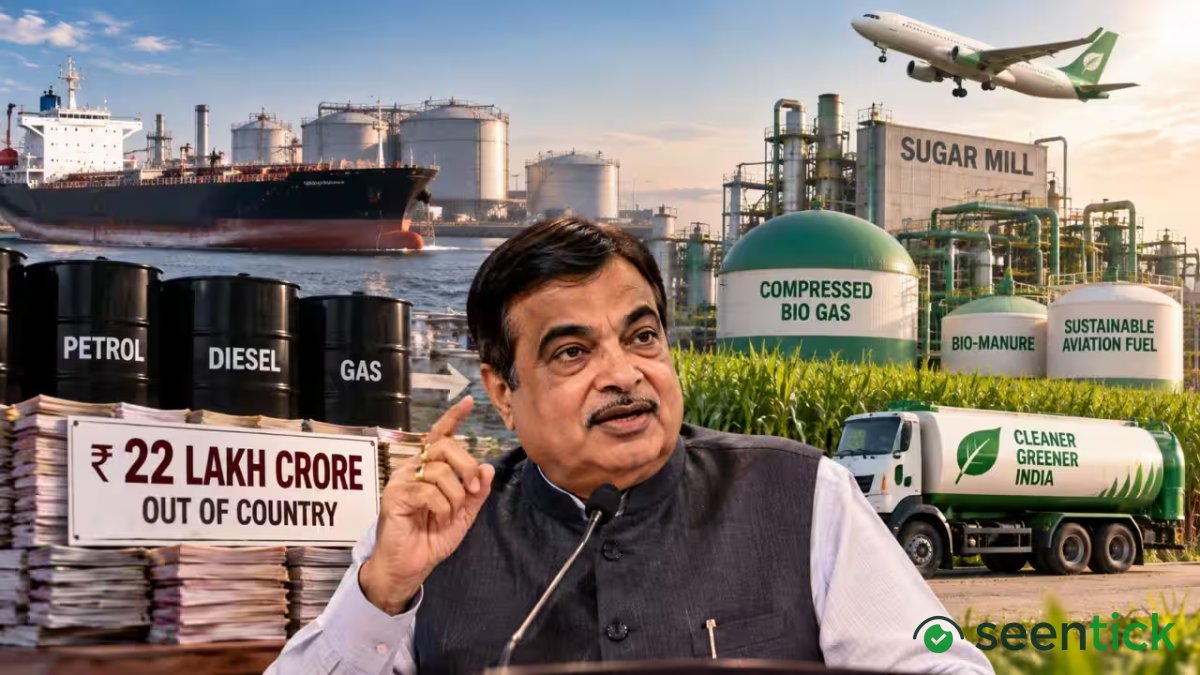
Gadkari Urges Sugar Mills to Diversify into CBG, Aims to Reduce Rs 22 Lakh Crore Fuel Imports
Key Highlights
- Sugar industry can produce 50,000 tonnes of CBG per day.
- Diversifying into CBG can improve returns for farmers.
- FASTag adoption can reduce fuel imports by Rs 20,000-25,000 crore per year.
Nitin Gadkari, Union Minister for Road Transport and Highways, has urged sugar mills to diversify into compressed bio-gas (CBG) and other value-added by-products to reduce the country's reliance on imported fossil fuels. According to Gadkari, the sugar industry has the potential to generate significant revenue and create jobs by producing CBG, which can be used as a cleaner alternative to fossil fuels.
Gadkari pointed out that India imports most of its fuel. This includes crude oil, LPG, and LNG, and that the sugar industry can play a key role in reducing these imports. He said that the sugar industry has the potential to produce 50,000 tonnes of CBG per day.
Read More: Retired Teacher's Rs 1.33-Crore Deposit Sparks ITAT Ruling on Reassessment Notice Timing
However, currently produces only around two per cent of that capacity.
"The future of plain sugar is mediocre at best. I won't mince words: diversifying into complementary by-products guarantees a strong future," Gadkari said.
"When the system will go fully live, then our department alone would deliver a benefit of Rs 20,000-25,000 crore per year to the Government of India because of the use of FASTags,".
Also Read: India to Study US Tariffs Targeting Russian Oil Imports Amid Rising Energy Tensions
Gadkari said that diversifying into CBG can help sugar mills improve their returns and pay farmers as much as Rs 6,000 per tonne of sugarcane. Compared with the current Rs 4,000. He also highlighted the potential of CBG to address stubble burning and air pollution while creating wealth in rural areas.
Gadkari also emphasized the importance of FASTag adoption in reducing fuel imports. He said that the government is targeting the removal of barriers from all toll plazas on national highways by March 2027 as part of its plan to make toll collection completely barrier-free.
What's Your Reaction?
 Like
Like
 Dislike
 Love
1
Love
1
 Funny
Funny
 Wow
2
Wow
2
 Sad
Sad
 Angry
1
Angry
1

I write about the forces shaping business and the global economy, from startup growth and changing markets to international trade and policy. My work focuses on breaking down complex developments into clear, practical insights and understanding what they could mean for businesses, investors, and the wider economy.












Comments (0)