

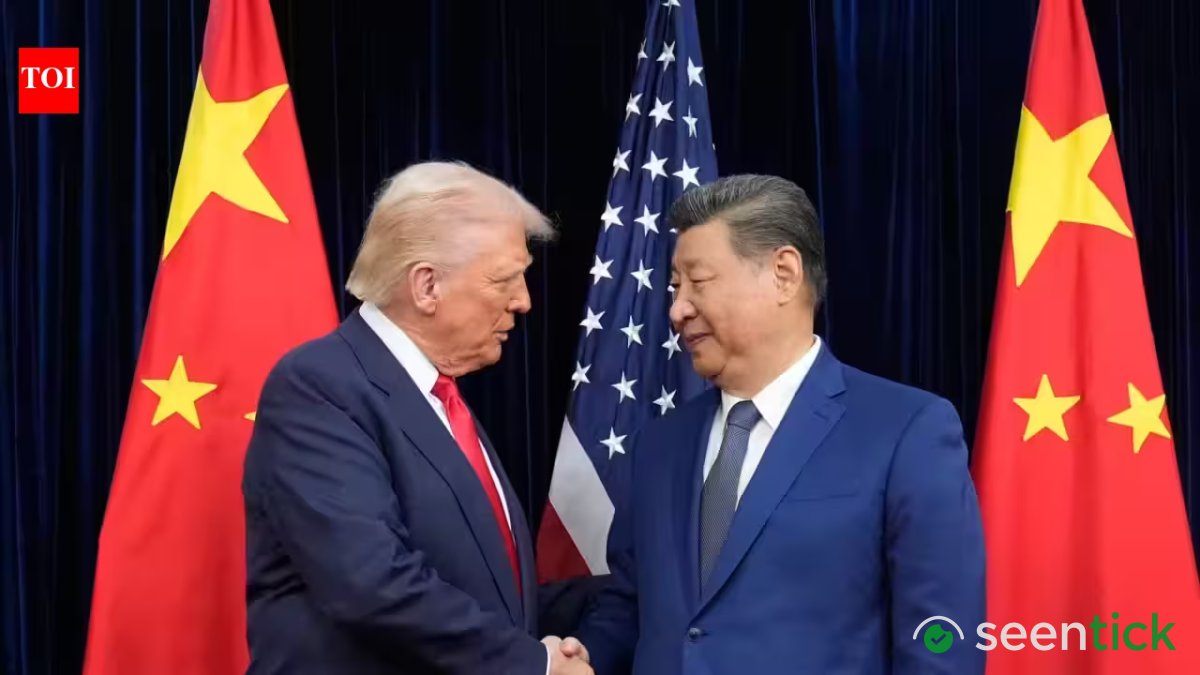
Trump and Xi Jinping Meet Amid Rising Tensions Over Tariffs and AI
Key Highlights
- India's manufacturing opportunity driven by US-China rivalry.
- US-India TRUST initiative encompasses semiconductors and AI.
- China dominates rare earths processing, giving Beijing economic leverage.
Chinese President Xi Jinping's recent three-day state visit to Washington marks a significant development in US-China relations. The visit comes as US President Donald Trump welcomes Xi to the White House. Setting the stage for discussions on key issues such as tariffs, artificial intelligence, and rare earths.
However, India is not on the agenda, leaving the country with significant interests at stake.
The "just in time" approach has driven India's manufacturing opportunity, as companies sought to diversify their supply chains in response to the US-China rivalry. The PLI scheme has attracted investment in electronics. Telecom equipment, pharmaceuticals, and other industries, resulting in expanded electronics production and a growing Indian footprint.
However, if US-China relations become more predictable, China's advantages could erode, and India may struggle to replicate the country's established supplier networks, world-class infrastructure, and skilled labor.
Read More: NSE IPO: Existing Shareholders Retain Majority Stake Despite Selling Shares in Offer-for-Sale
The US-India TRUST initiative now encompasses a broad range of areas. This includes semiconductors, artificial intelligence, quantum technology, critical minerals, biotechnology, energy, and space. The two sides are exploring ways to manage the risks associated with increasingly powerful AI models.
While the US remains committed to maintaining its technological advantage, permitting more "non-sensitive" technology commerce with China could grant US companies access to a vast market, while Chinese firms would gain additional room to operate.
Rare earths are essential to the production of electric vehicle motors, wind turbines, electronics, and advanced weapons. China's dominance in rare earths processing gives Beijing significant economic leverage. India and the US have signed a Strategic Critical Minerals Cooperation Framework, which covers mining, processing, recycling, financing, and resilient supply chains.
India is separately developing rare-earth corridors in Odisha, Kerala, Andhra Pradesh, and Tamil Nadu.
India and China are both major purchasers of energy from countries that the US wants to isolate. The Trump administration is seeking to reduce Chinese purchases of Iranian oil. Meanwhile, US pressure on Russian energy has placed India in a sensitive position.
Also Read: Vande Bharat Express Paves Way for India's Bullet Train Era
If Beijing receives exemptions, tariff relief, or other concessions as part of a wider bargain, India would be closely watching the energy fine print.
The rise of the Quad - India. The US, Japan, and Australia - cannot be separated from anxiety about China's growing influence in the Indo-Pacific region. A US-China detente does not address India's concerns about China's growing presence.
The US-India critical-minerals framework, signed this year, is already in force, and the Quad remains a vital strategic partnership in the region.
What's Your Reaction?
 Like
2
Like
2
 Dislike
 Love
1
Love
1
 Funny
Funny
 Wow
1
Wow
1
 Sad
Sad
 Angry
Angry

I write about the forces shaping business and the global economy, from startup growth and changing markets to international trade and policy. My work focuses on breaking down complex developments into clear, practical insights and understanding what they could mean for businesses, investors, and the wider economy.










Comments (0)