

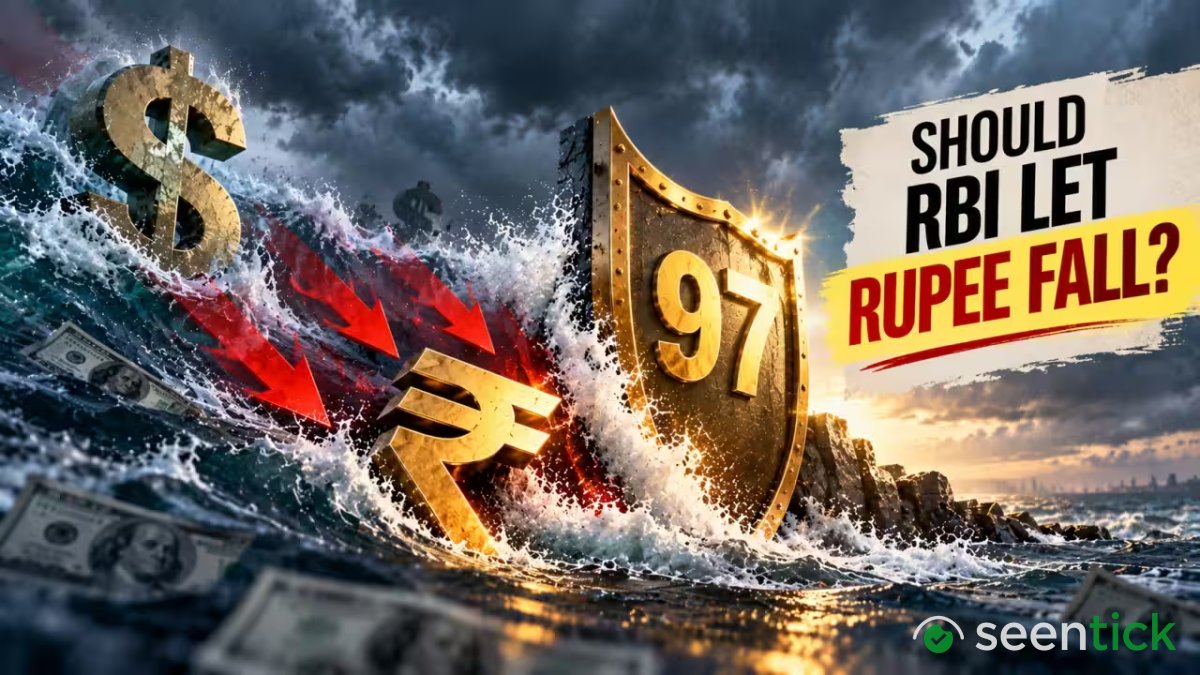
RBI Unveils Measures to Stabilize Rupee Amid Global Uncertainty
Key Highlights
- RBI raises CRR maintenance to 99%.
- RBI announces Rs 25,000 crore OMO sales.
- RBI tightens foreign exchange derivative regulations.
The Reserve Bank of India has taken decisive action to address the rupee's prolonged decline. This has been a major concern for several quarters. The bank has raised the daily cash reserve requirement (CRR) maintenance to 99% and implemented measures to tighten liquidity in the system.
Additionally, the RBI has strengthened its foreign exchange derivative regulations, including a reduction in the threshold for taking FX derivative positions.
According to Vivek Kumar, Economist at QuantEco, the RBI's measures are a comprehensive package aimed at addressing both internal and external macro pressures. The dual focus on increasing the price of money and restricting its availability is an appropriate policy response to emerging inflation and currency risks.
Read More: Gold Prices Surge 54%, Jewelers Flock to Diamonds as Consumers Seek Value
However, Kumar notes that the effect of these measures may be short-term, and the underlying pressure on the rupee persists due to factors such as a firm dollar, elevated energy prices, and continued portfolio outflows.
Ranen Banerjee, Partner and Leader, Economic Advisory at PwC India, suggests that the RBI's measures will help address the pressures on the rupee caused by speculative trades. Banerjee notes that the measures are aimed at making the supply of forex more orderly for oil companies and making the demand for forex more real and less speculative.
However, Banerjee also emphasizes the need for the government to address long-pending structural issues regarding capital inflows, such as abolishing the long-term capital gains tax on equities.
DK Srivastava, Chief Policy Advisor at EY India, notes that the US dollar remains overvalued and the rupee undervalued. Srivastava suggests that the RBI should continue to guide the rupee along a trend consistent with inflation differentials. The ongoing rising US bond yields are attracting capital flows into the US, including from India.
This is adding pressure on the rupee and deepening its undervaluation.
Also Read: Tenant Loses Case Over Rs 10 Lakh Security Deposit
Radhika Rao, Senior Economist and Executive Director at DBS Bank, cautions against the potential fallout of allowing the rupee to depreciate. Rao notes that while exchange-rate flexibility is essential. Policymakers must also be mindful of the risk that one-way currency depreciation can become self-reinforcing.
Preventing a disorderly depreciation is therefore as important as preserving flexibility.
Sanjay Malhotra, RBI Governor, believes that the rupee is actually undervalued. Malhotra emphasizes the importance of examining inflation-adjusted exchange rates against trading partners, productivity, and the external balance in determining valuation. A fundamentally undervalued currency can weaken temporarily when dollar demand exceeds supply.
What's Your Reaction?
 Like
3
Like
3
 Dislike
 Love
Love
 Funny
Funny
 Wow
1
Wow
1
 Sad
Sad
 Angry
Angry

I write about the forces shaping business and the global economy, from startup growth and changing markets to international trade and policy. My work focuses on breaking down complex developments into clear, practical insights and understanding what they could mean for businesses, investors, and the wider economy.












Comments (0)