

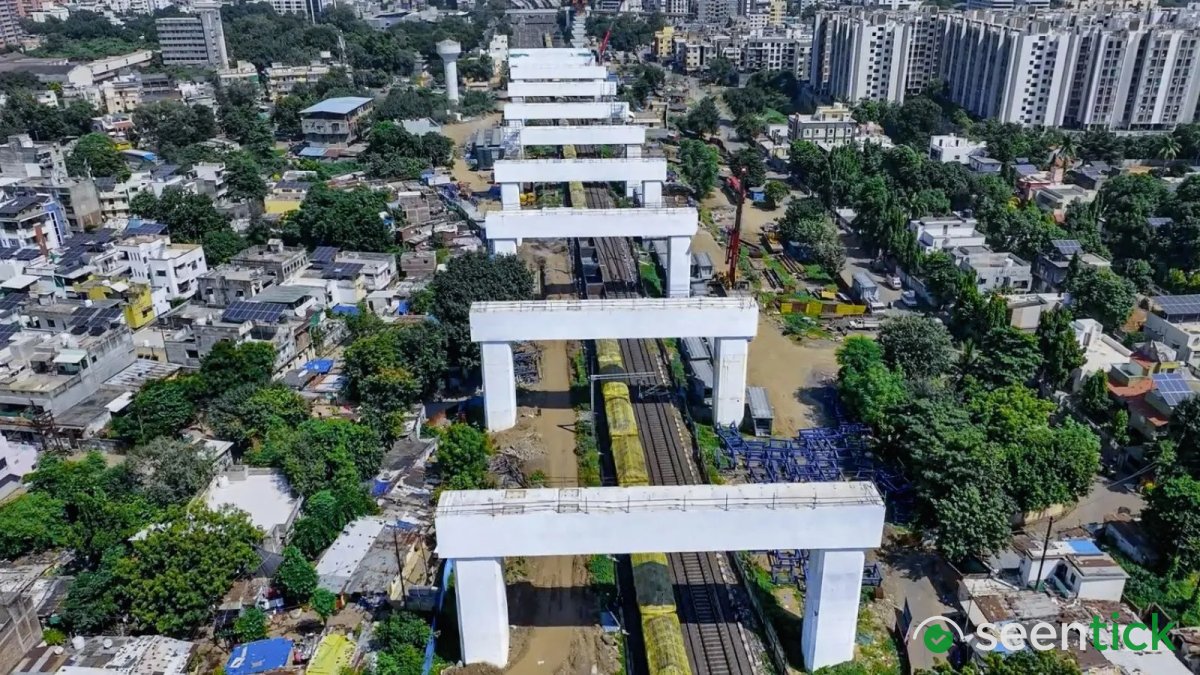
India's Bullet Train Project Completes 14 Portal Beams Over Delhi-Mumbai Rail Route in Vadodara
Key Highlights
- NHSRCL completes 14 portal beams over Delhi-Mumbai Rajdhani railway line in Vadodara.
- Portal beams weigh approximately 1,500 tonnes.
- Construction to resume with launching 40-metre-long composite girders.
India's First Bullet Train Project Takes a Major Leap Forward with Completion of Portal Beams.
The National High Speed Rail Corporation Limited (NHSRCL) has completed the construction of all 14 portal beams over the Delhi-Mumbai Rajdhani railway line in Vadodara. This marked a significant milestone in India's first bullet train project. The portal beams, weighing approximately 1,500 tonnes, were built using the cast-in-situ method to accommodate operational railway infrastructure.
The completion of the portal beams satisfies a major structural requirement for launching the 40-metre composite girders over the Rajdhani main line and advancing the elevated corridor through this critical section. The construction of these structures necessitates the use of high-capacity cranes, hydraulic jacks, long-boom concrete pumps, and precision surveying equipment.
Read More: CJP Activists Detained in Rajasthan Ahead of Delhi Protest
At the Vadodara portal site, engineers had to contend with space and structural limitations. This prompted the construction of beams that span 37 metres in length. These beams, measuring 4 metres in width and height, necessitated the use of 590 cubic metres of concrete and a 55-tonne steel reinforcement cage.
The construction of these structures requires careful planning and precise execution to minimize disruptions to the operational railway infrastructure. NHSRCL has emphasized the importance of detailed sequencing.
Continuous monitoring, close coordination with Indian Railways, and controlled railway blocks wherever required to ensure the successful completion of the project.
The completion of the portal beams marks a significant achievement in the construction of India's first bullet train project. Showing the corporation's commitment to delivering high-quality infrastructure that meets the demands of high-speed rail operations. The next phase of construction will focus on launching the composite girders.
This will pave the way for the completion of the elevated viaduct.
Also Read: JNU Sacks Congress MP Bimol Akoijam Over Harassment Plaints
The successful completion of the portal beams is a shows the collaboration between NHSRCL and Indian Railways. This highlights the importance of coordination and cooperation in delivering complex infrastructure projects. The project is expected to create new employment opportunities and stimulate economic growth in the region.
The portal beams were constructed using the cast-in-situ method, which involves pouring concrete into a formwork structure to create the desired shape. This method allows for the creation of complex structures while minimizing the impact on operational railway infrastructure.
Construction is expected to continue at a steady pace, with the launching of composite girders scheduled to commence shortly. The project timeline is expected to be completed within the next several months.
What's Your Reaction?
 Like
2
Like
2
 Dislike
 Love
Love
 Funny
Funny
 Wow
3
Wow
3
 Sad
Sad
 Angry
1
Angry
1

Tech journalist and AI enthusiast who enjoys keeping up with the latest in hardware, processors, emerging AI tools, and software. I like digging into new technology, understanding how things actually work, and following the developments that could shape the way we use technology in the future.











Comments (0)