

The 10 Best Endings in Film History
The 10 Best Endings in Film History
- There are some major spoilers regarding the films discussed. A brilliant movie isn’t just about a moment or two, a legendary performanc
- And those films that end in a masterful manner tend to earn forever praise. It’s easy to wrap up a story neatly with a bow, but that’s
- But what makes an incredible ending? Well, these ten films know a thing or two about sensational finales. From a shocking revelation to
There are some major spoilers regarding the films discussed. A brilliant movie isn’t just about a moment or two, a legendary performance, or box office numbers. A genuinely perfect film must have all that and still be exceptional from beginning to end.
And those films that end in a masterful manner tend to earn forever praise. It’s easy to wrap up a story neatly with a bow, but that’s boring. A great ending must be earned and leave a lasting impact .


For related coverage, explore our detailed analysis on Technology and Digital Systems.
What Makes Incredible Ending Updates
But what makes an incredible ending? Well, these ten films know a thing or two about sensational finales. From a shocking revelation to a poetic conclusion, a great movie should end in a way that properly completes the narrative and leaves the audience feeling satisfied.
A great ending must be worth sitting through until the credits end. These films do just that. Some have inspired subsequent movies.
Others have influenced other filmmakers to find their own iconic buttons that emulate these movies. While there are certainly many more films that could have slipped onto this list, these ten endings represent a great cross-section of cinema history and genres.
Of all the films on this list, All That Jazz may be one of the more underrated films of all time.
Directed Perhaps Reason Sensational Updates
Directed And perhaps a reason why is that sensational conclusion. The film is a semi-autobiographical film based on the director himself. The dazzling yet cynical musical drama follows Joe Gideon ( Roy Scheider ), a workaholic director juggling a chaotic personal life, prescription drugs, and impending mortality.
He has an endless line of women, his family life is crumbling, and physical and mental stress is taking its toll on a consummate professional. A raw look into the pressures of the industry, balancing work with life and love, All That Jazz is greatly remembered for Fosse’s sizzling choreography and the surreal sequences .
The very best comes at the end. We may ponder how our final moments might play out on our deathbed-Fosse envisioned it for Joe via razzle-dazzle and all that jazz.
A dying Joe hallucinates a massive, glamorous television variety show led ” It’s a grand conclusion that celebrates himself, his life, and his loves as a cavalcade of characters from his past appear in celebration.
The sequence blurs the line between his internal ego, regret, and the final stages of dying where Angelique ( Jessica Lange ), the alluring woman in white representing death, waits at the end of the spectral runway. At the end, his corpse is zipped up in a body bag.
The final scene flourishes with brilliant showmanship and, like a Broadway show, wraps up the entire journey through song .
But it’s that shockingly jarring dose of reality that serves as a harrowing reminder that death is finite. Truth and illusion are united through thematic closure. One man’s ego may aggrandize his life, but Joe’s exit from life is just like everyone else’s.
All That Jazz simply couldn’t end any other way . There are very few romantic dramas that hold a candle to Casablanca .
The 1942 classic directed Rick must choose between his lingering love for his former lover, Ilsa Lund ( Ingrid Bergman ), and helping her husband, Victor Laszlo ( Paul Henreid ), a resistance leader, escape the Nazis Rick’s moral dilemma leaves him torn between his personal desire for Ilsa and the broader global fight against fascism , forcing him to make the greatest decision.
Casablanca ends the way it must: with the ultimate gesture and one of the most romantically heartbreaking lines ever uttered: “We’ll always have Paris.” The final scene of the film finds Rick and Ilsa on the tarmac at the foggy airport. Rick convinces Ilsa to board a plane to freedom with her husband.
But it’s not that easy.
Rick shoots the Nazi Major Heinrich Strasser ( Conrad Veidt ) who tries to stop them, and French Captain Renault ( Claude Rains ) protects Rick " It’s implied that Renault has now joined the Free French cause. As the plane departs, Rick and Renault walk into the fog together, Rick’s states, "Louis, I think this is the beginning of a beautiful friendship".
One of the most iconic endings with a brilliant quote, Casablanca concludes with the ultimate sacrifice. Rick’s line to Ilsa before he sends her away serves as his acknowledgment that while they have had incredibly sweet moments together, they simply cannot be.
Casablanca trades away a typical Hollywood ending for an emotionally mature, cliche-free action of political duty and nobility.
This is literally the opposite of riding off into the sunset. It’s a bittersweet parting, but truly the only way hope can be found in the darkness. Hands down, one of the greatest neo-noir mysteries in Hollywood history is Chinatown .
Directed Gittes uncovers a horrific family connection involving Evelyn's father, Noah Cross ( John Huston ), in a finale that instantly cements the film's legacy. Inspired Jake tries to help Evelyn flee to Mexico with her daughter/sister Katherine Cross ( Belinda Palmer ), only to be confronted As Evelyn fires a shot against her abusive father, a law enforcement personnel officers officers officer blindly fires at her, killing Evelyn instantly.
Cross, like the monster he is, cradles the mortified young girl, who is both his daughter and grandchild, ultimately being the one to lead her to safety. Jake, who has seemingly lost the war, is whisked away as the infamous line, "Forget it, Jake. It's Chinatown," is uttered in his ear.
It's a devastating blow that proves that corruption can succeed and justice will not prevail. Cross is deemed largely untouchable as this myth of "Chinatown" represents a system where the rules don't make sense and trying to do so can lead to greater tragedy. The scene may be harrowing, but it's thematically brilliant.
Jake represents a hero whose intervention triggers loss. Chinatown 's ending serves as a reminder that the Hollywood ideal is that one single person cannot pause a powerful, systemic evil.
There are a lot of things that the original Planet of the Apes is known for, but it's that final image that will remain its most recognizable and resounding.
Directed Schaffner , the original Planet of the Apes is based on the novel The science fiction film follows a group of human scientists, led Chimpanzee scientists Dr. Zira ( Kim Hunter ) and Dr. Cornelius ( Roddy McDowall ) befriend Taylor and try to help him, but the menacing orangutan Dr.
Zaius ( Maurice Evans ) tries to hide proof that humans were once the superior intelligence. Planet of the Apes is a film about survival, but what happens when you learn the hard truth about the dangerous world you fell upon? Welcome to that final moment.
As science fiction Hollywood films tended to do, the protagonist would be able to fight his way to freedom. Taylor and a mute human named Nova ( Linda Harrison ) escape into the Forbidden Zone away from the ape city. Though a confrontation between Taylor and Dr.
Zaius arrives, it's the latter who knows the truth of what's beyond. Taylor and Nova escape, riding horses along the coastline, only to discover the remains of the Statue of Liberty buried in the sand.
The revelation comes as Taylor discovers he did not travel across the galaxy and that humanity was responsible for its own demise, revealing the escape was futile.
"We finally really did it. You maniacs! You blew it up!
Ah, damn you! Goddamn you all to hell!" he exclaims on his knees, ending on an ultimate low. Planet of the Apes concludes to serve as a cautionary tale about humans' self-destructive nature .
For a film from 1968, it wasn't necessarily prophetic, but its reality has yet to be altered . The dystopian conclusion of humanity destroyed Crime thrillers often end with the villain getting apprehended and the cops walking off into the sunset.
Then came Se7en , and that concept was flipped for one of the most shocking endings in thriller history.
Directed Se7en was destined to deliver on the horrible murders for each sin, but audiences truly never expected the killer's grand finale to be as horrible as it was. After a relentless search, the killer finally decides to turn himself in to the law enforcement personnel officers officers.
Covered in blood, Doe leads the two detectives to a remote field where he alleges the final two victims are.
Suddenly, a van arrives with a mysterious box. Instructed to open it, Somerset opens the box to great dismay as he discovers the severed head of Mills' wife, Tracy ( Gwyneth Paltrow ). Left in complete shock, John Doe confesses to murdering Tracy out of envy for Mills' perfect life.
He then provokes Mills In complete despair, Mills fulfills the killer's need for wrath, shooting John to death. And just like that, the serial killer's mission is complete: his 7-part murder spree was fulfilled with the last two victims squarely in the field.
Mills and Somerset believed they were about to ride off with a killer in their control, only for their lives to be upended.
Mills' life and career are shattered, and Somerset, quoting Ernest Hemingway , does not retire; he decides to fight for the world he lives in. An utterly perfect end to a psychological thriller, Se7en provides the absolute destruction of the protagonist's moral code Se7en alleges that there can never be any morally perfect heroes.
Pitt famously fought for the devastating ending, feeling the righteous conclusion did not serve the story.
He was right. Your answers have pointed to one Oscar Best Picture winner above all others. This is the film that was made for the way your mind works.
You are drawn to films that operate on multiple levels simultaneously — that begin in one genre and quietly, brilliantly migrate into another. Bong Joon-ho's Parasite is a film about class, desire, and the architecture of inequality that manages to be darkly funny, deeply suspenseful, and genuinely shocking across a single extraordinary running time.
Your instinct is for cinema that hides its true intentions until the moment it's ready to reveal them.
Read More: Every Stanley: Kubrick Movie of the '60s, Ranked
Parasite is exactly that — a film that rewards close attention and punishes assumptions, right up to its devastating final image. You are drawn to cinema on a grand scale — films that understand history not as a backdrop but as a force, and that place their characters inside that force and watch what happens.
Christopher Nolan's Oppenheimer is a film about the terrifying gap between what we can do and what we should do, informed with the full weight of one of the most consequential moments in human history behind it. You want your films to feel important without feeling self-important — to earn their ambition through sheer craft and the gravity of their subject.
Oppenheimer does exactly that. It is enormous, complicated, and refuses easy comfort. You are drawn to films that foreground their own building work — that make the how of the filmmaking part of the what it's about.
Alejandro González Iñárritu's Birdman, shot to appear as a single continuous take, is cinema examining itself through the cracked mirror of a fading actor's ego. You respond to formal daring, to the feeling that a film is doing something that probably shouldn't be possible.
Michael Keaton's performance and Emmanuel Lubezki's restless camera create something genuinely unlike anything else — a film that is simultaneously about creativity, relevance, self-destruction, and the impossibility of ever truly knowing if your work means anything at all.
You are drawn to cinema that trusts silence, that refuses to explain itself, and that treats dread as a form of meaning. The Coen Brothers' No Country for Old Men is a film about the arrival of a new kind of evil — implacable, arbitrary, and utterly indifferent to the moral frameworks we use to make sense of the world.
It is one of the most formally controlled films ever made, and its controlled restraint is what makes it so terrifying. You want your films to haunt you, not comfort you. You are not interested in resolution if resolution would be dishonest.
No Country for Old Men is honest in a way that most cinema never dares to be. Going out in a blaze of glory never looked more incredible than in Thelma & Louise .
The iconic buddy dramedy directed But their weekend getaway turns into a desperate race across the American Southwest when they become accidental outlaws after Thelma is assaulted After deciding to head to Mexico rather than turn themselves in, t hey make the ultimate decision that leads to one of the most daring and iconic moments in cinema history.
After a long chase, the law enforcement personnel officers officers eventually catch up with the titular characters and their 1966 Ford Thunderbird. With surrender behind them and death in front of them, Thelma and Louise decide that rather than going to prison, they'll "keep going." With a mutual smile and hands held, they agree to accelerate the car and soar right off the cliff.
The film ends with an infamous freeze-frame with the Thunderbird suspended in mid air before a cinematic white-out. Even though we know the answer is tragic, this moment is why this ending was pitch-perfect. Their decision is the ultimate act of freedom and self-autonomy.
They spent the film fighting against being victims of circumstance. Now, they emerge as agents of their own destiny. Scott keeps the car in flight to immortalize freedom.
It solidifies their ultimate bond: mutual liberation from society's bounds. The scene was not only a fitting finale but also an important liberation for those watching. Though no one wants to meet the same end, Thelma & Louise 's epic ending made the film the ultimate road trip film.
Though many bibliophiles and cinephiles know Stephen King as the King of Horror, there are some stories on his resume that go beyond the genre. The greatest drama he's ever written, Rita Hayworth and the Shawshank Redemption , was turned into a brilliant film adaptation, written and directed The brilliant film tells the story of Andy Dufresne ( Tim Robbins ), a banker wrongly convicted of murder.
He's sentenced to life in a brutal Maine penitentiary where he befriends another inmate, Ellis Boyd "Red" Redding ( Morgan Freeman ). Over two decades, Andy uses his financial skills to survive in a corrupt prison, inspire fellow inmates, and quietly plot his path to freedom .
One might think that a King story would end on a bad note, but The Shawshank Redemption concludes with a message of hope, optimism, and friendship.
For 19 years, Andy had been tunneling through his cell wall with a small rock hammer. After pushing through what seems to be an endless maze of raw sewage, Andy finds his way to freedom, where he exposes the warden, Samuel Norton's ( Bob Gunton ) money laundering and corruption under a fake identity he prepared.
But wait, there's more. Red is paroled and struggles to adjust to the outside world. But Andy didn't leave him hanging.
Having remembered a promise he made, Red visits a hayfield in Buxton, Maine, where he finds a hidden box under a black volcanic rock, containing cash and an invitation to join Andy in Mexico. Choosing hope over despair, Red breaks his parole and reunites with his friend, as they jovially embrace on a beach, finally finding peace and solitude.
The Shawshank Redemption 's emotionally earned conclusion proves that there may actually be a light at the end of the tunnel. Andy's journey was a meticulous plan operated as quiet revenge.
He beat the system Mexico served as an almost distant myth, but seeing it offers the audience an opportunity to witness abstract hope become a practical reality.
The film cuts to black over the vast Pacific Ocean, allowing the audience to relish the limitless freedom their characters dreamed of. We may be in prisons of our own, but with hope and resilience, our ocean is attainable. As you can tell, the '90s were filled with some iconic endings.
Whether satisfying or shocking, they left a lasting impact, but it was one massive twist no one saw coming that helped cement a director's stardom. Written and directed Night Shyamalan , the psychological thriller The Sixth Sense follows child psychologist Dr.
Malcolm Crowe ( Bruce Willis ) as he seeks to help a young patient, Cole Sear ( Haley Joel Osment ), who can communicate with the dead.
Malcolm advises Cole to pause running from the ghosts and instead listen to them and try to help them resolve their unfinished business. The Sixth Sense is a mind-blowing example of practicing what you preach , as the finale revealed one of the greatest shocks in cinema history.
As a great psychologist hopes to, Malcolm ultimately helps Cole reconnect with his overwhelmed single mother, Lynne ( Toni Collette ).
Now, it was his turn to return home and speak to his wife, Anna ( Olivia Williams ), who had previously been distant and cold to him. But there was one clue that was hiding in plain sight: Cole telling Malcolm that dead people "only see what they want to see" and don't know that they're dead.
At home, he sees his sleeping wife drop his wedding ring, realizing it's missing on his own finger. Malcolm finally remembers that the gunshot wound from the beginning of the film was due to being shot A shot that he did not survive.
It was only then that the dead Malcolm could tell his wife that she was never second to him, giving him and Anna the closure they needed.
Malcolm helped Cole, who in turn helped him because, when Cole shared he "sees dead people," he meant him . Though some claim they could have seen it coming, the major twist recontextualized the entire film. Shyamalan masterfully misdirects the audience Malcolm only interacts with Cole and Anna.
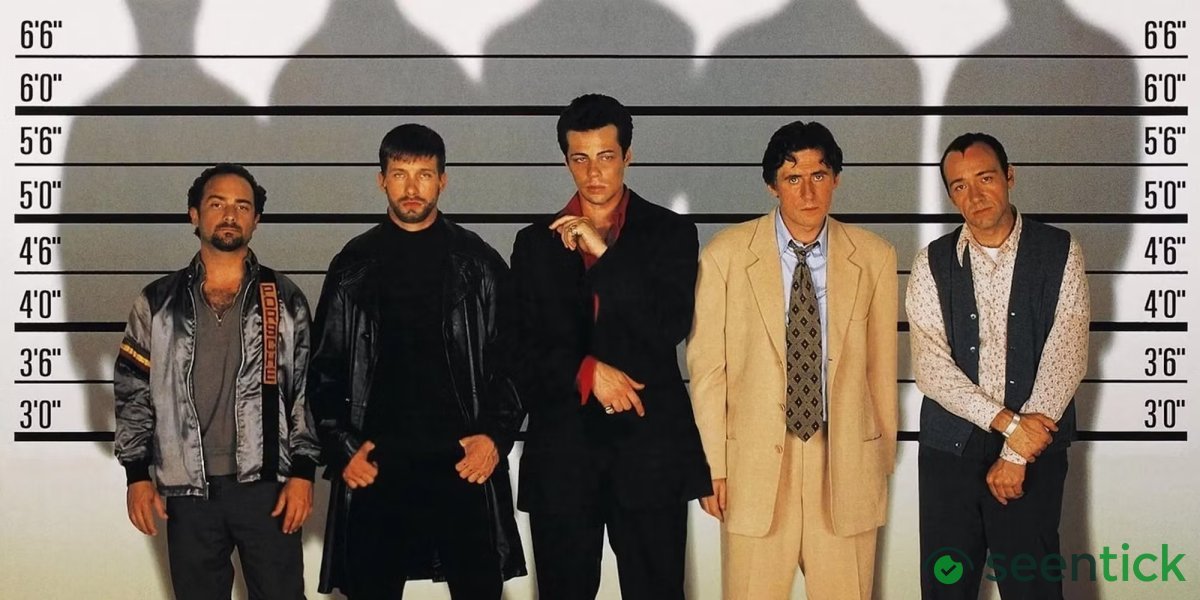
And even then there are closed dialogue loops. The Sixth Sense set up our expectations of twist endings from the director , but none ever achieved the same brilliant shock. In another prime example of a twist ending, The Usual Suspects made you realize you simply cannot trust anyone.
Especially if they're criminals. Directed He’s interrogated S. Customs Agent Dave Kujan ( Chazz Palminteri ) and recounts a convoluted story detailing how he and four other high-profile criminals-a corrupt ex-cop Dean Keaton ( Gabriel As Verbal weaves his complicated tale, the identity of Söze’s becomes the film’s greatest mystery and twist.
The Usual Suspects is a mark of brilliant storytelling. The entire film follows a man spinning a tale. Verbal frames his dead associate, Keaton, as the mythical criminal mastermind.
Kujan accepts the story as truth, feeling satisfied that the case is solved. With Verbal gone, a proud Kujan looks around the room, suddenly realizing that every name, brand, and detail in Verbal's story was completely fabricated on the spot as he built his narrative while sitting in the room.
His revelation comes too late as Verbal is gone, having already picked up his belongings.
As Verbal walks down the street, he drops his limp, straightens his posture, and lights a cigarette with his steady hand. He gets into a waiting car, driven The film ends with Kujan recalling Verbal's previous statement, "The greatest trick the devil ever pulled off was convincing the world he didn't exist." Verbal Kint was Keyser Söze all along.
The Usual Suspect is the blueprint in misdirection , meaning a two-hour crime thriller was built on an elaborate lie that everyone, audience included, went along with. Spacey delivers a remarkable performance in one of his most iconic roles. Like Kujan, why wouldn't the audience believe him?
The payoff is simple: the film emerges as a rewatchable classic that dares you to pick up the clues that were hiding in plain sight. There are very few films quite as beloved as The Wizard of Oz . From mesmerizing visuals, iconic songs, and an iconic career-making performance, The Wizard of Oz had it all.
And that included a perfect ending. Based on the book Frank Baum , the film tells the story of Dorothy Gale ( Judy Garland ), a young Kansas girl who is swept away Accompanied Along the way, Dorothy must overcome challenges and battle a vengeful Wicked Witch of the West ( Margaret Hamilton ).
A timeless story of self-discovery and inner empowerment, the film was more than just a story with a strong moral anchor; it was a reminder that our imagination is only as powerful as we make it.
At the end of the film, Dorothy gets her wish as she has the power to return home to Kansas. All she has to do is click her ru" And she does! She says good But Dorothy's happily ever after doesn't pause there.
The technicolor is gone as Dorothy wakes up in her sepia-toned world, in the comfort of her own bed. She's surrounded "And you were there, and you were there, and you were there..." she says, realizing each and every person was a character she met in Oz .
The moral of the story is Dorothy didn't need to search for her heart's desire in far-off technicolor lands.
There truly is no place like home. It serves as a reminder that life holds more value than any dream that we wish. It's a beautiful and tender scene and perfectly bookends the story.
There was truly no other manner in which The Wizard of Oz could end.
Frequently Asked Questions
What's Your Reaction?
 Like
1
Like
1
 Dislike
0
Dislike
0
 Love
1
Love
1
 Funny
1
Funny
1
 Wow
1
Wow
1
 Sad
0
Sad
0
 Angry
0
Angry
0

Movies, series, and everything happening around Indian entertainment keep me busy. I cover OTT releases, box-office conversations, celebrity news, and the changing world of streaming, with a particular interest in the stories and trends that audiences are talking about right now.









Comments (0)