


BRICS Nations Unveil New Delhi Declaration on Early Childhood Care and Education
Key Highlights
- The New Delhi Declaration promotes cooperation in Early Childhood Care and Education (ECCE) and Foundational Literacy and Numeracy (FLN).
- The declaration recognizes the importance of the BRICS Technical and Vocational Education and Training (TVET) Cooperation Alliance (BRICS-TCA).
- India has welcomed the initiative to circulate the BRICS Guiding Principles on strengthening academic collaboration on traditional and indigenous knowledge systems.
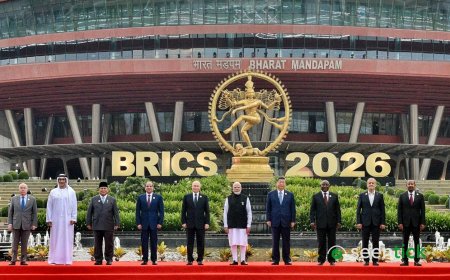
The 18th BRICS Summit has culminated in a landmark New Delhi Declaration that signals a profound shift in the bloc’s educational priorities, placing Early Childhood Care and Education (ECCE) and Foundational Literacy and Numeracy (FLN) at the center of its multilateral agenda. Building upon the foundational outcomes of the 13th BRICS Education Ministers’ meeting held in Bhubaneshwar last month, member nations have committed to a robust framework of cooperation.
The Declaration explicitly advocates for the sharing of best practices and the mutual recognition of qualifications, a move designed to facilitate seamless academic and professional mobility across the member states. Furthermore, the commitment to "safe, ethical, and human-centred" integration of Artificial Intelligence and emerging digital tools highlights a proactive approach to modernizing classroom infrastructure while safeguarding educational integrity.
Read More: Saiyyad Khan Acquitted After Assault in Bhopal Court
Critical Pillar Delhi Declaration Heightened
A critical pillar of the New Delhi Declaration is the heightened focus on the BRICS Technical and Vocational Education and Training (TVET) Cooperation Alliance (BRICS-TCA). Recognizing the key role of vocational training in driving economic growth and industrial stability, the bloc has formalized its support for the upcoming BRICS-TCA Biennial Progress Report and the Compendium of Sustainable Skill Initiatives.
Industry analysts suggest that this emphasis is a direct response to the widening skills gap observed across global labor markets. This alignment is intended to foster innovation and expand employment opportunities, particularly within Science, Technology, Engineering, and Mathematics (STEM) fields, where the transition from theoretical education to practical application remains a challenge for emerging economies.
In a move that distinguishes this iteration of the BRICS education agenda, the Declaration reaffirms the bloc's dedication to indigenous and traditional knowledge systems. Welcoming India’s initiative to circulate the "BRICS Guiding Principles" on academic collaboration, the summit encouraged the BRICS Network University-the consortium of top-tier universities from the member nations-to formally incorporate these systems as a new International Thematic Group.
Also Read: BRICS Space Agencies Unveil Progress in Remote Sensing Satellite Constellation Agreement
This integration represents a strategic effort to bridge the gap between contemporary academic rigour and local wisdom, potentially positioning BRICS as a unique leader in culturally contextualized pedagogy. Beyond curriculum expansion, the Declaration calls for a significant overhaul of institutional governance to enhance educational quality and accessibility.
This framework not only aims to standardize educational benchmarks across the bloc but also seeks to build a sustainable, future-ready workforce capable of addressing the challenges of a digital-first global society while preserving the unique heritage and knowledge paradigms of the Global South.
Frequently Asked Questions
What's Your Reaction?
 Like
1
Like
1
 Dislike
 Love
Love
 Funny
Funny
 Wow
3
Wow
3
 Sad
Sad
 Angry
Angry

Tech journalist and AI enthusiast who enjoys keeping up with the latest in hardware, processors, emerging AI tools, and software. I like digging into new technology, understanding how things actually work, and following the developments that could shape the way we use technology in the future.










Comments (0)