

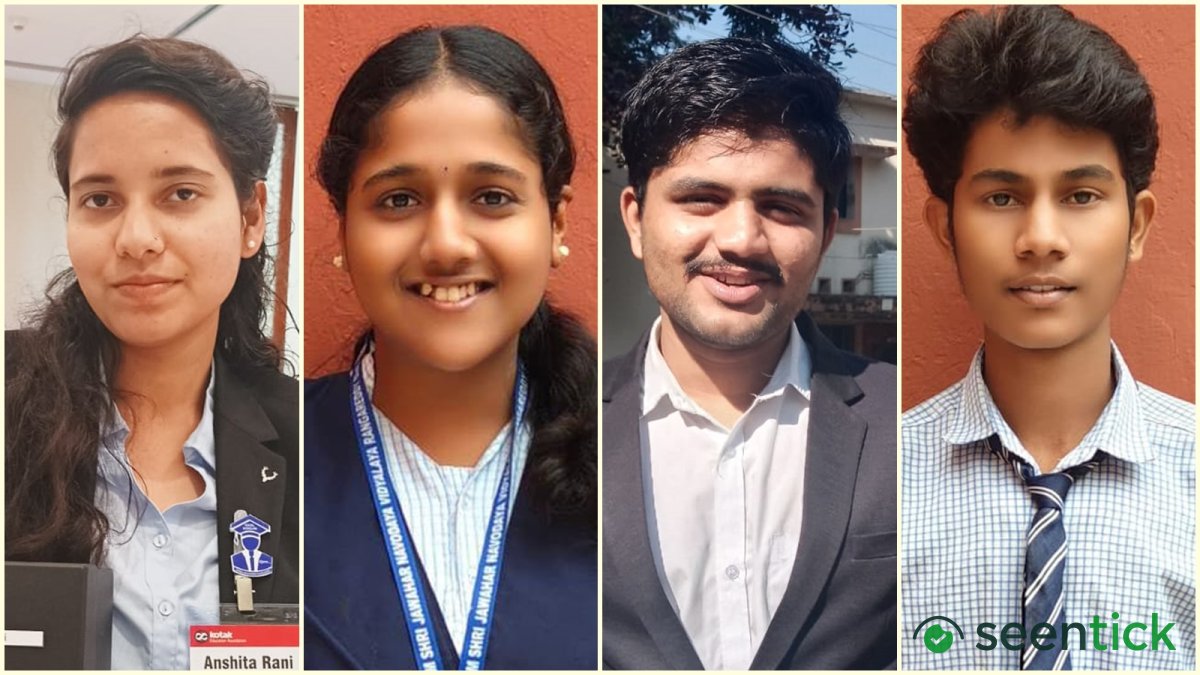
Anshita Rani: How Navodaya's NLSP Programme is Empowering Rural Students to Become Lawyers
Key Highlights
- NLSP identifies promising students at Navodaya schools.
- Programme prepares students for CLAT and supports them through law school.
- students completed the two-year programme and went to law school.
On the evenings when there were power cuts in Hapur’s Athsaini village in Uttar Pradesh. Anshita Rani’s father would come home to find her sitting in the dark with a book she couldn’t read. So he bought her a rechargeable lamp.
At 23 and in the final year of the five-year law course at National Law University, Jodhpur, Anshita still has that lamp. It’s old now and considerably weakened, but it still holds a special place for her.
Barely Works Now But Still
“It barely works now, but we still have it,” she says. For Anshita, the lamp was a reminder of her journey, made possible not only.
Started in 2019 as a collaboration between Navodaya Vidyalaya Samiti and its alumnus Anoop Maurya. The NLSP is a fully funded two-year residential programme. For students like Anshita, it presents an opportunity they never had before.
Anshita’s family was poor and large — a joint family of 22 people living under one roof. Means were few, the house was always crowded, and finding a quiet corner to study was often a challenge.
Anshita Had Never Given Law
Anshita had never given law serious consideration. That is, until Anoop Maurya’s NLSP visited her school and introduced the residential programme. “I had always wanted to do something where people would listen to what I had to say,” she says.
“When Anoop sir spoke about people from backgrounds like ours becoming leaders and shaping policy, it resonated with me.”.
In 2022, she successfully cracked CLAT and joined JLU. This phase has been challenging to adjust to - the feeling of being left behind But Anshita knows these are just hiccups.
“When I met people from across the country – people who are far more confident, articulate and worldly, I realised how small my world had been,” she says. “There were so many things that I had never known or heard of.”.
Every year, the NLSP conducts outreach sessions across the Navodaya network, reaching roughly 10,000 students, mostly from rural backgrounds. Tests across the 600+ JNV schools comprise two written exams and an interview.
While the written exams test school coursework, the interview checks students’ aptitude, potential, background and inclination. The two-year programme, too, is just as intense, accepting only 30 students each year. Students who qualify move to their campus, currently in Hyderabad, where they study at the local JNV school.
Of the 150 scholars selected for the programme in the last seven years. 120 completed the two-year NLSP residential programme and went to law school. Of these, 84 are still pursuing law — 54 at NLUs.
For many students, NLSP offered not just coaching but a sense of direction. Among them is Vedant Ravindra Deshmukh. For the 21-year-old from Maharashtra’s Wardha, law was never a viable career option: his father often liked to say: “Lawyers can't even afford soap to wash their coats.”.
Also Read: BRICS Nations Unveil Four New Agriculture Initiatives to Boost Climate Resilience and Productivity
It was quite an unusual classroom setting for Vedant that led him to participate in the NLSP test. He topped the exam across Navodaya schools in three states in 2023. What followed was two years of struggle against family pressure and financial constraints that appeared to make CLAT more and more distant.
Finally, he joined Rashtrasant Tukadoji Maharaj Nagpur University, formerly known as Nagpur University, also with NLSP’s help. “I also struggled a lot with confidence, but it was the alumni network that helped me improve,” he says. “Being shown d.
Now, there are other concerns - such as seeking internships and jobs. Applications go unanswered, calls are frequently ignored, and worry mounts.
reports suggest like I’m constantly trying to catch up she says. Vedant, meanwhile, has had that chance. Last year, while interning with a law firm, he worked on a matter involving a major airline — something he considers a feather in his cap.
When a response came back from a bigger firm. He says he sat looking at the letterhead for a while before he could read the rest of it. “I thought maybe I could work there someday.”.
Frequently Asked Questions
What's Your Reaction?
 Like
2
Like
2
 Dislike
 Love
Love
 Funny
Funny
 Wow
2
Wow
2
 Sad
Sad
 Angry
Angry

Tech journalist and AI enthusiast who enjoys keeping up with the latest in hardware, processors, emerging AI tools, and software. I like digging into new technology, understanding how things actually work, and following the developments that could shape the way we use technology in the future.












Comments (0)