

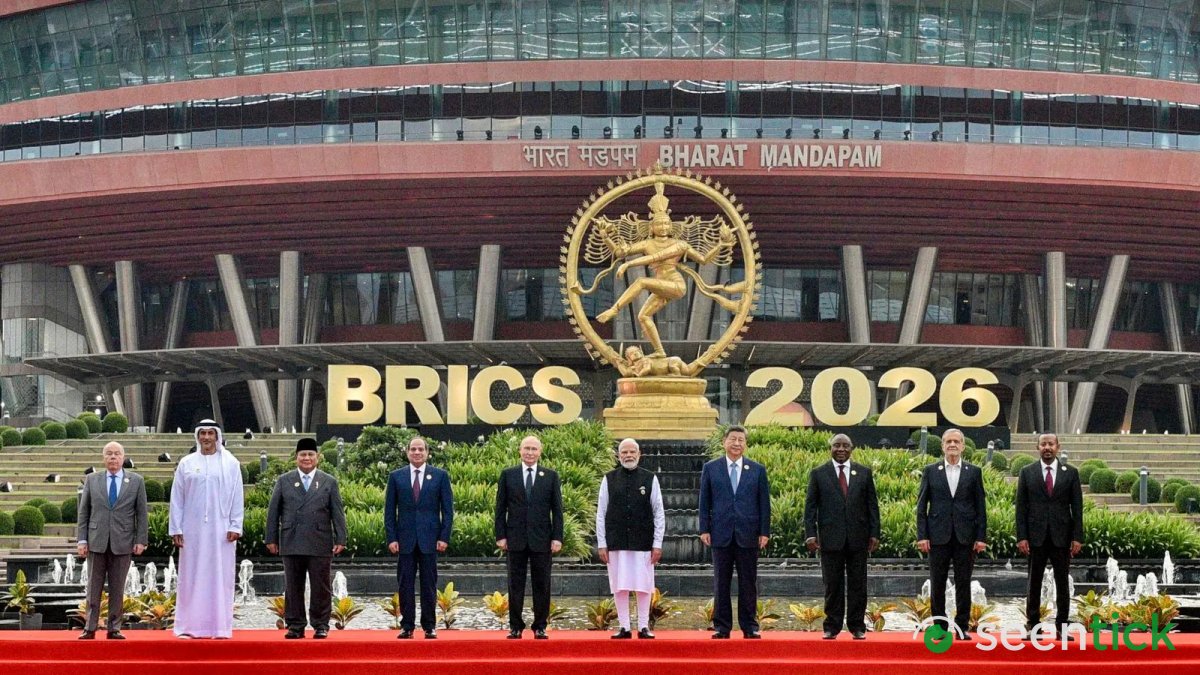
BRICS Declaration Opposes European Union's Carbon Border Tax, Acknowledges Fossil Fuels Role in Energy Mix
Key Highlights
- Key entity announced specific development on date.
- Confirmed metric or percentage from the story.
- Concrete outcome or verified next step.
The New Delhi Declaration: A Pivot in Global Energy Policy
The 18th BRICS Summit concluded with the adoption of the New Delhi Declaration, a policy document that signals a profound divergence from Western-led climate agendas. Against the volatile backdrop of the West Asia conflict, which has sent shockwaves through global energy security and supply chains, the bloc has chosen to prioritize the economic survival of developing nations.
This stance is rooted in the principle of “common but differentiated responsibilities,” a core tenet of international climate law that recognizes that emerging markets require a more flexible, phased approach to transitioning away from coal and oil to avoid stagnating their critical industrial growth.
The declaration serves as a direct rebuttal to the European Union’s Carbon Border Adjustment Mechanism (CBAM). For nations like India, China, and Russia-who represent four of the world’s five largest coal consumers-the carbon border tax is viewed not as an environmental necessity, but as a neo-protectionist tool designed to handicap their manufacturing sectors.
Read More: As India probes origin of 5 baby orangutans, Indonesia prepares ground for repatriation
The document emphasizes that such measures fundamentally undermine the spirit of the Paris Agreement, arguing that any transition must be “just, orderly, and equitable,” rather than dictated
Infrastructure, Finance, and the Demand for Technological Equity
Beyond its opposition to border levies, the declaration places a heavy burden on developed nations to facilitate the climate transition through tangible support. The BRICS bloc has explicitly called upon wealthier nations to provide “additional, adequate, predictable, and accessible financial resources,” alongside comprehensive technological transfers.
This demand underscores a recurring grievance within the Global South: that the financial burden of climate adaptation-often necessitated While the member nations have made significant, rapid investments in renewable energy infrastructure, the declaration makes it clear that electricity grids in the Global South remain tethered to traditional fuels, and that
Furthermore, the summit highlighted the deepening nexus between climate change and disaster risk management. Following the recent, devastating flash floods in Nepal, the bloc moved to formalize cooperation on disaster mitigation.
This pragmatic cooperation extends to ecological preservation, as evidenced With its headquarters in New Delhi, the Alliance represents a shift toward collaborative conservation for species ranging from the tiger to the jaguar, mirroring the broader BRICS goal of “mainstreaming biodiversity protection” under the Kunming-Montreal Global Biodiversity Framework (KM-GBF).
Also Read: Ex-Havildar Arrested in Secunderabad Cantonment Arms Heist
Industrial and Civic Implications of the BRICS Stance
The geopolitical implications of the New Delhi Declaration are substantial. This creates a difficult landscape for multinational corporations operating across both jurisdictions; they must now navigate two distinct regulatory realities: one governed The pushback against the CBAM is likely to trigger further legal challenges at the World Trade Organization, as the bloc positions itself to defend the sovereign right of emerging economies to utilize their own resources.
Ultimately, the declaration frames the climate debate as an issue of equity rather than just atmospheric science. This strategy is designed to ensure that the Global South does not repeat the developmental mistakes of the past, but also does not surrender its competitive edge in the global market to protect European environmental standards.
The coming years will reveal whether this coalition can effectively force the hand of Western donors to unlock the promised climate finance, or if the chasm between the Global North’s “green” mandates and the Global South’s “growth-first” energy reality will continue to widen.
Frequently Asked Questions
What's Your Reaction?
 Like
2
Like
2
 Dislike
 Love
Love
 Funny
Funny
 Wow
1
Wow
1
 Sad
Sad
 Angry
1
Angry
1

Tech journalist and AI enthusiast who enjoys keeping up with the latest in hardware, processors, emerging AI tools, and software. I like digging into new technology, understanding how things actually work, and following the developments that could shape the way we use technology in the future.











Comments (0)