

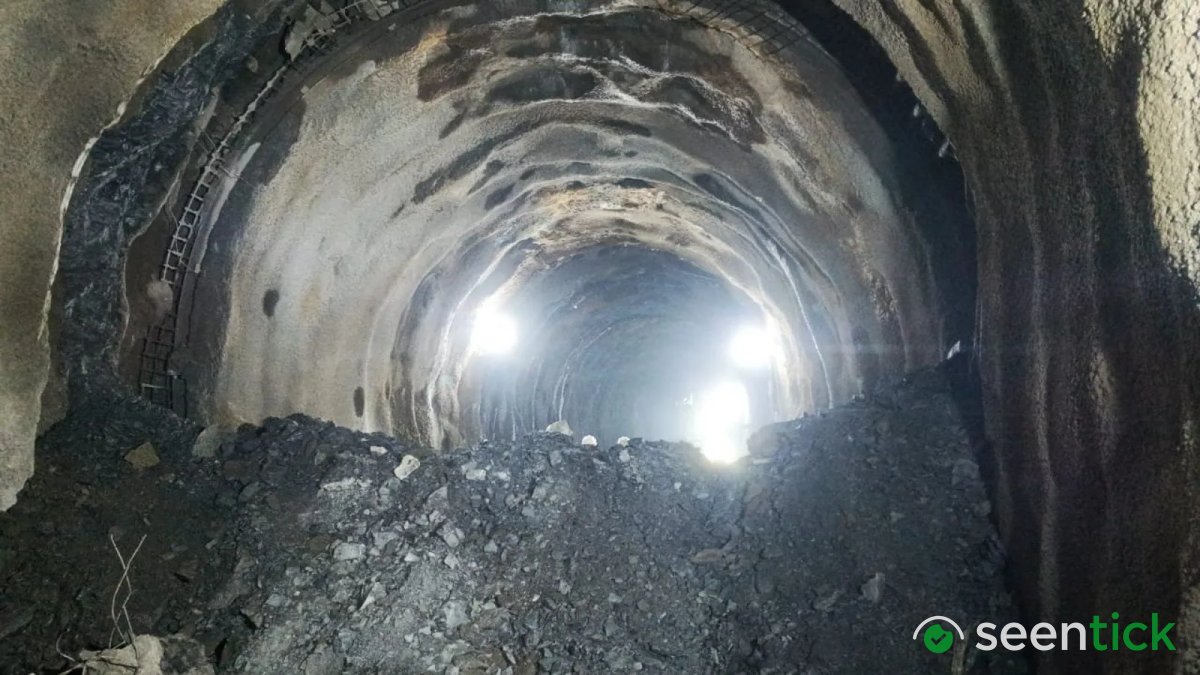
Railway Project Achieves Major Breakthrough, Moves Closer to Completion
Key Highlights
- Rishikesh-Karnaprayag rail project: The Rishikesh-Karnaprayag rail project has achieved another major milestone with the final breakthrough of Escape Tunnel-1 on September 11, 2026.
- With this breakthrough, the project has now recorded 41 tunnel breakthroughs, bringing the much-anticipated Himalayan railway project closer to completion.
- The project is being developed Once completed, it will improve rail connectivity in Uttarakhand and make travel to the Himalayan region easier.
The Rishikesh-Karnaprayag rail project reached a critical juncture on September 11, 2026, with the successful breakthrough of Escape Tunnel-1. Spanning an impressive 10.847 kilometers, this structure now stands as the second-longest tunnel within the entire 125-kilometer rail network.
This milestone marks the 41st successful tunnel breakthrough for the project, a reflects the sophisticated engineering required to navigate the volatile Himalayan landscape. The construction process was fraught with geological hurdles, as the alignment traverses highly tectonized, multi-folded, and extensively faulted rock formations.
According to reports from the Ministry of Railways, the presence of widespread shearing and intense localized crushing-exacerbated The completion of this segment demonstrates the structural resilience and technical precision maintained
Read More: Odisha's Industrial Revamp: A New Chapter with UAE Investors
September 2026 Overall Progress 125Km
As of September 2026, the overall progress of the 125-km rail link is officially pegged at 78 percent, with tunnel excavation nearing completion at 97 percent. The scope of this ambitious infrastructure endeavor is vast, involving 16 main tunnels spanning 104 kilometers and 12 dedicated escape tunnels covering approximately 98 kilometers.
RVNL Chairman and Managing Director (CMD) Saleem Ahmad recently emphasized the operational momentum, noting that with only five additional breakthroughs required, the project is rapidly transitioning from the excavation phase to the track-laying and systems-integration stage. This railway corridor is designed to be the backbone of transport in Uttarakhand, passing through the strategic districts of Dehradun, Tehri Garhwal, Pauri Garhwal, Rudraprayag, and Chamoli.
The implications of this railway are far-reaching, particularly for the pilgrimage and tourism sectors that define the regional economy. Beyond tourism, the rail line serves a vital civic purpose The project’s successful navigation of the MBT zone-an area known for seismic vulnerability-has provided invaluable geological data that may influence future infrastructure projects in the Himalayan belt.
As the project nears its targeted completion, it remains a centerpiece of the national initiative to achieve integrated connectivity, promising to transform the socio-economic landscape of Uttarakhand while reinforcing national security through improved access to border regions.
Also Read: Southern Railway Achieves 100% Broad Gauge Network Electrification
Ministry Railways Has Lauded Collective
The Ministry of Railways has lauded the collective effort behind this achievement, highlighting that the synergy between engineers, geologists, and specialized workforce personnel was instrumental in overcoming the daunting geological conditions. "Successfully completing the excavation and achieving the final breakthrough through such complex geological conditions reflects the technical expertise, perseverance, teamwork, and commitment of all stakeholders involved," the Ministry stated in an official release.
With the final five tunnel breakthroughs slated for the coming year, the focus is shifting toward the finalization of bridge construction and station infrastructure. Stakeholders remain optimistic that the project will meet its remaining milestones on schedule, effectively positioning Uttarakhand for a new era of industrial and transit-oriented development.
The successful realization of this rail link represents a landmark victory for infrastructure planning in high-altitude environments, setting a new benchmark for future mountainous railway networks across the Indian subcontinent.
What's Your Reaction?
 Like
2
Like
2
 Dislike
 Love
Love
 Funny
Funny
 Wow
2
Wow
2
 Sad
Sad
 Angry
Angry

Tech journalist and AI enthusiast who enjoys keeping up with the latest in hardware, processors, emerging AI tools, and software. I like digging into new technology, understanding how things actually work, and following the developments that could shape the way we use technology in the future.











Comments (0)