

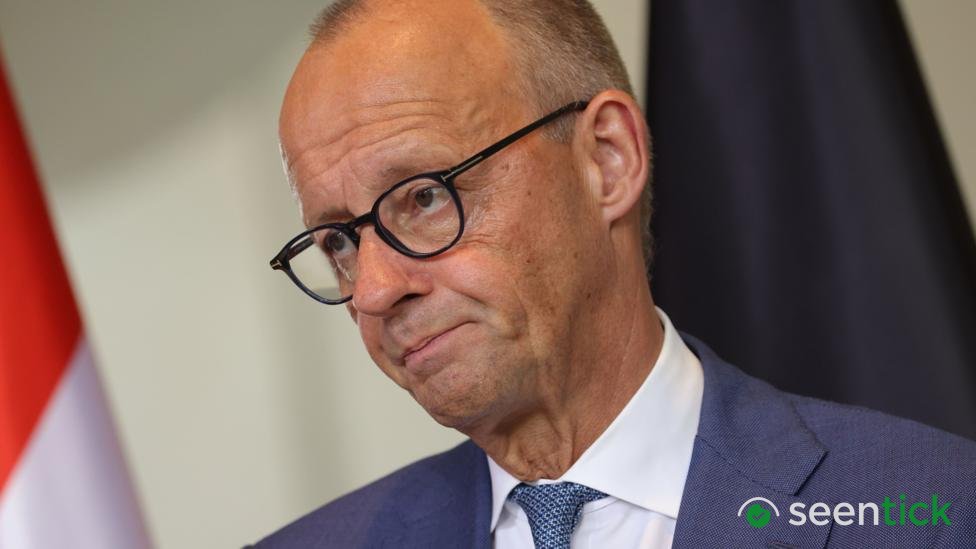
Eight German state premiers back Merz amid speculation over future
Key Highlights
- Eight German state premiers pledge support for Chancellor Friedrich Merz.
- AfD surges to 43.8% of the vote in Saxony-Anhalt.
- Merz's approval ratings remain low.
Eight German state premiers have pledged their support for Chancellor Friedrich Merz, amid growing speculation about his political future. The premiers, all members of Merz's Christian Democratic Union (CDU), wrote that restoring trust in the party lay in "listening and taking political action, not in debates over personnel".
Merz, who has only held the post for 16 months, is facing poor approval ratings while the anti-immigration, far-right Alternative for Germany (AfD) party is surging. This prompted questions about whether he is an electoral liability. He has vowed to carry on but two more state elections on Sunday have been seen as a key test of his leadership.
The AfD shot up to 43.8% of the vote while the CDU plummeted to 17.2%. This marked the first time since World War Two that a far-right party has come close to controlling a German state.

Read More: Catania Airport Grounds Flights Due to Volcanic Ash from Mount Etna
The chancellor's abrasive communication style and personal unpopularity - with just 14% thinking he is right for the job. According to a recent Bild poll - have raised questions about his viability as leader of both Germany and the CDU.
CDU authorities will meet on Sunday to co-ordinate the party's response to the results of that day's state elections in Berlin and Mecklenburg-West Pomerania - where the AfD is poised for further gains and the CDU for further losses.
Rumours of a "Kanzlertausch" - or "Chancellor swap" - have been around for months, but they have increased since the conservative CDU tumbled to a distant second behind the AfD in the eastern state of Saxony-Anhalt at the start of September.

Merz came out fighting after the loss, describing the AfD - which wants to rebuild ties with Russia - as a "destructive force" whose migration policy amounted to an "ethnic cleansing" of skilled workers.
Also Read: Colombian ex-foreign minister charged over nanny's lie detector test
In Mecklenburg-West Pomerania, polls put the AfD ahead of the centre-left SPD but likely well short of an outright majority. The worst-case scenario for Merz would be for the CDU to lose power in Berlin and not get enough votes to even have a presence in Mecklenburg-West Pomerania's parliament.
Unlike in the UK, Germany is not well-versed in replacing its leader mid-term, though Merz could, in theory, be pressured to resign or face a vote of no confidence, though many regard that outcome as unlikely.
No one within the CDU has yet shared they were willing to challenge Merz. However, the speculation about his future has led to several names - including Söder, North Rhine-Westphalia premier Hendrik Wüst and German Interior Minister Alexander Dobrindt - being touted as potential successors.
Even before Merz had officially been made chancellor, he managed to rally support for a massive €500bn ($547bn. £420bn) defence infrastructure fund, with his straight-talking style and focus on European security earning him plaudits on the world stage.
This suggests that he has a history of struggling to appeal to even those within his own ranks - and that he may be unlikely to let go of a job he has long coveted.
Frequently Asked Questions
What's Your Reaction?
 Like
3
Like
3
 Dislike
 Love
Love
 Funny
Funny
 Wow
1
Wow
1
 Sad
Sad
 Angry
Angry

I write about the forces shaping business and the global economy, from startup growth and changing markets to international trade and policy. My work focuses on breaking down complex developments into clear, practical insights and understanding what they could mean for businesses, investors, and the wider economy.












Comments (0)