
The answer: Buffalo meat the shipments of which surged 6% to $5.1 billion
Which is India’s best-performing agricultural export item?
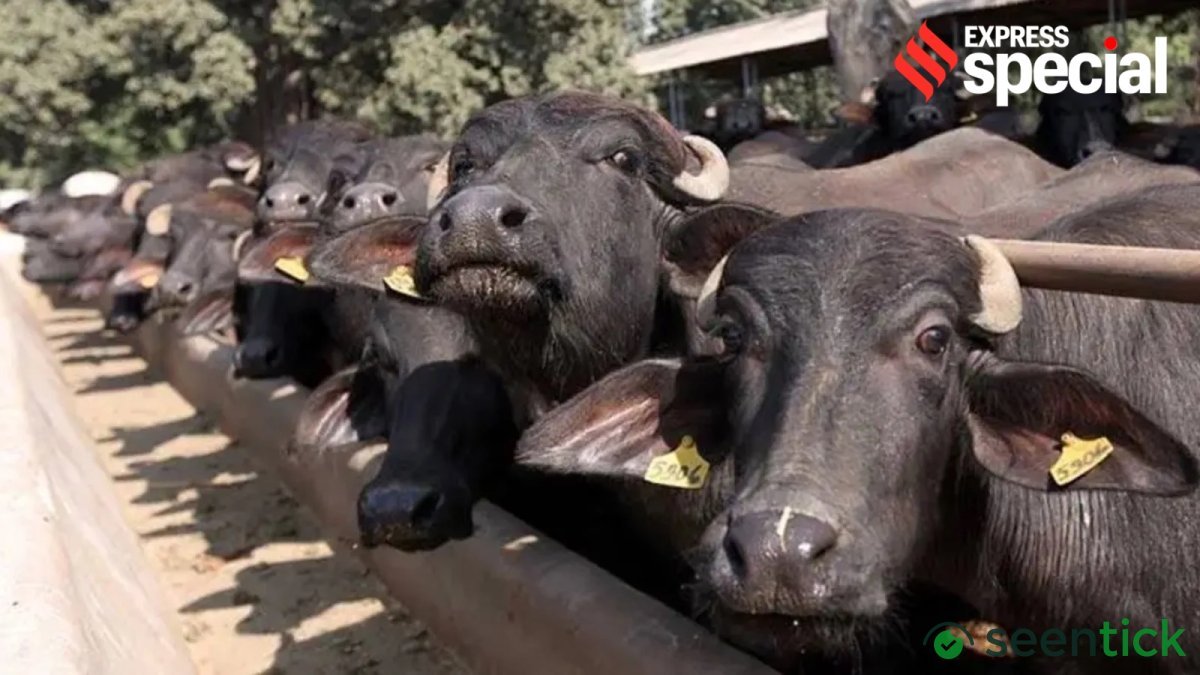
The answer: Buffalo meat, the shipments of which surged 6% to $5.1 billion in 2025-26 (April-March). The current fiscal has seen further growth, a whopping 66.6% from $896.8 million in April-June 2025 to nearly $1.5 billion in April-June 2026.


“We crossed $5 billion for the first time last fiscal and are on track to do $6 billion-plus in 2026-27,” said a Commerce Ministry official.
But it’s not just overall value increase. More impressive is the value realisation per tonne.
In 2014-15, India exported 14.8 lakh tonnes (lt) of buffalo meat worth $4.8 billion, translating into an average value of $3,240 per tonne. The subsequent years till 2023-24 recorded a drop in the value as well as quantity of exports (see charts), and also average realisations to $2,700-3,000 levels.
The revival started in 2024-25, when exports touched $4.1 billion at a unit value of $3,236 per tonne. The latter number rose to $3,591 in 2025-26 and $4,392 during April-June 2026.
“The higher unit value realisations indicate improved product acceptability of Indian buffalo meat. This has been enabled We also ensure ongoing compliance through periodic and surprise inspections,” the official explained.
India has 83 APEDA-approved integrated abattoirs-cum-meat processing plants that can handle between 500 and 2,000 large animals (buffaloes) each daily. In addition, there are five standalone slaughterhouses and 10 meat processing plants registered
“In the last couple of years, we have consciously worked at making Indian buffalo meat a global brand and not a number two alternative to cattle beef. The world too is recognising our product quality and safety standards,” claimed Fauzan Alavi, secretary of the All-India Buffalo and Sheep Meat Exporters Association.
This is reflected in Indian buffalo meat being previously exported at $3,000 per tonne versus $5,000 for Brazilian beef. That gap or discount has since reduced to $500-700 per tonne
Read More: Navy to lease two new MQ-9B Sea Guardian unmanned aircraft with US firm
India is the world’s third largest bovine meat exporter. Its projected volume of 17 lt (in carcass weight equivalent) for 2026 is next to Brazil’s 42.8 lt and Australia’s 21.6 lt, as per US Department of Agriculture data. The country’s top three exporters are the Mumbai-based Allanasons Private Ltd, the Abu Dhabi-headquartered LuLu Group-owned Fair Exports India, and HMA Agro Industries, Agra.
Indian buffalo meat, also called carabeef, is widely used for processed industrial foods such as sausages, burger patties, emulsified nuggets, canned and ready-to-eat products. But there’s a concerted attempt now at boosting value realisation
APEDA has, since October 29, been imposing a Rs 250/tonne levy on exports of all frozen and chilled buffalo meat. The proceeds go towards a Meat Export Development Fund, similar to the one created for basmati rice in 2008.
“The fund is meant for promoting exports, both to new and existing markets. It covers activities from sponsoring trade delegation visits and international buyer-seller fairs, to addressing non-tariff barriers restricting market access,” the earlier-quoted official added.
That these efforts are bearing fruit is borne out
In 2014-15, 45% of India’s $4.8 billion buffalo meat exports went to Vietnam ($2.2 billion), followed 9 million), Egypt ($422.3 million), Thailand ($393.4 million), Saudi Arabia ($259 million), United Arab Emirates ($130.8 million), Algeria ($125.1 million) and Philippines ($115.8 million).
Cut to 2025-26, where out of the total $5.1 billion, 10 countries imported over $100 million worth each: Vietnam ($933.9 million), Egypt ($725 million), Malaysia ($654.1 million), UAE ($444.2 million), Saudi Arabia ($359.3 million), Uzbekistan ($307 million), Indonesia ($301.3 million), Iraq ($300.1 million), Philippines ($176.6 million) and Jordan ($105.5 million).
“Uzbekistan is a new market. So are others that have become significant buyers: Russia ($97.5 million), Georgia ($70.5 million), Oman ($82.7 million) and Senegal ($70.9 million),” the official noted.
The success story of buffalo meat exports isn’t limited to market expansion leading to higher unit value realisations. It also ticks all the right boxes with respect to India’s livestock economy and its dairy farmers.
India doesn’t permit export of beef (cattle meat). Even export of carabeef is from buffaloes that do not produce enough milk after around five calvings/lactations (when they would be 8-9 years old), are infertile, have damaged udders or happen to be male. For farmers, maintaining them is uneconomical, both direct and indirect in terms of diverting fodder, feed, water and labour resources away from bovines giving milk now or in future.
What's Your Reaction?
 Like
0
Like
0
 Dislike
0
Dislike
0
 Love
0
Love
0
 Funny
0
Funny
0
 Wow
0
Wow
0
 Sad
0
Sad
0
 Angry
0
Angry
0

SeenTick is a digital news platform bringing you the latest and most important stories from India and around the world. Explore news and updates across politics, business, technology, AI, gaming, health, sports, entertainment, science and more.












Comments (0)