

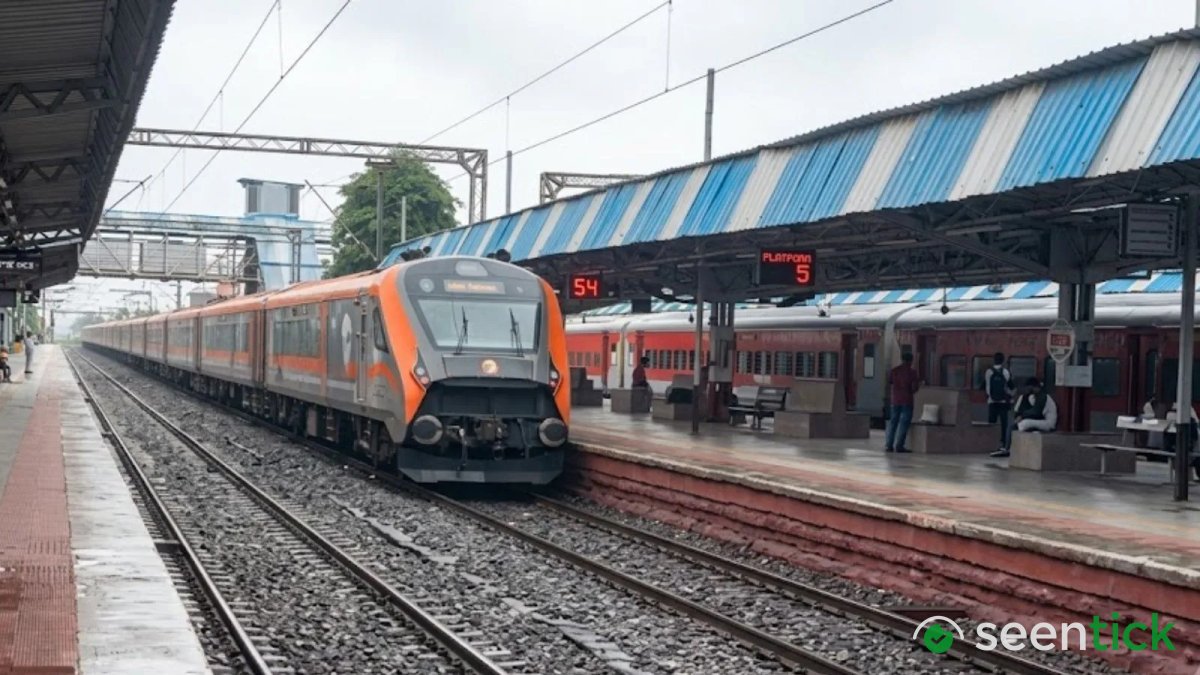
India's First Vande Bharat Freight Train Reaches 130kmph During Trial Run on Ahmedabad-Mumbai Route
Key Highlights
- Vande Bharat freight EMU trial run: India's first Vande Bharat freight train has reached a speed of 130 kmph during its trial run on the Ahmedabad-Mumbai Central route.
- The trial is being conducted Developed The train could be used to carry e-commerce shipments, courier packages, electronics, pharmaceuticals, cold-chain products and other high-value goods.
- "It is intended to provide a modern alternative to conventional freight trains, particularly for fast, reliable and time-bound parcel transportation," the Railway said in a statement.
Vande Bharat Freight Train Reaches 130 kmph Speed During Trial Run
The Vande Bharat freight EMU train has successfully completed its trial run on the Ahmedabad-Mumbai Central route. Reaching a speed of 130 kmph. The train was operated with 50% payload and an axle load of 20.32 tonnes during the trial. According to Western Railway, the trial was conducted in adherence to permanent and temporary speed restrictions applicable on the section.
The Vande Bharat freight EMU rake was prepared at ICD Sabarmati and left Ahmedabad for Mumbai Central at around 9 am on September 12. The return trial from Mumbai Central to Ahmedabad was conducted on September 13.
"During the trial, the RDSO team received the necessary technical and operational support from the Mechanical, Electrical, and Signal & Telecommunication departments of the Ahmedabad Division," said a spokesperson for Western Railway.
Read More: Indian Railways Introduces Shared Season Ticket Facility on RailOne App
Modern Features of Vande Bharat Freight Train
The Vande Bharat freight EMU has several modern features aimed at making parcel transportation faster and safer. The train is equipped with 16-coach configuration. Refrigerated vans, wide automatic doors, roller flooring, CCTV surveillance, fire detection systems, and an automatic door-locking system.
These features are designed to provide a modern alternative to conventional freight trains, particularly for fast, reliable, and time-bound parcel transportation.
The Vande Bharat freight EMU has a design speed of around 160 kmph and is capable of carrying e-commerce shipments. Courier packages, electronics, pharmaceuticals, cold-chain products, and other high-value goods. The train's advanced stability and safety arrangements are designed to ensure safe operations at high speeds.
Also Read: Indian Railways Completes 100% Electrification of Assam's Broad Gauge Network
"It is not an alternative to heavy freight trains operating on Dedicated Freight Corridors (DFCs)," said a spokesperson for Western Railway.
Trial Results to Boost Express Logistics
The trial of the Vande Bharat freight EMU will help RDSO collect data on its performance and safety. The results will be used to assess the possibility of its future commercial operation. "The successful trial of the Vande Bharat Freight EMU opens up a new possibility in Indian Railways' freight transportation sector," said Ahmedabad Division of Western Railway.
The Vande Bharat freight EMU has the potential to boost express logistics The train's modern features and advanced safety arrangements make it an attractive option for transporting high-value goods.
Frequently Asked Questions
What's Your Reaction?
 Like
Like
 Dislike
 Love
Love
 Funny
Funny
 Wow
2
Wow
2
 Sad
Sad
 Angry
3
Angry
3

Tech journalist and AI enthusiast who enjoys keeping up with the latest in hardware, processors, emerging AI tools, and software. I like digging into new technology, understanding how things actually work, and following the developments that could shape the way we use technology in the future.










Comments (0)