

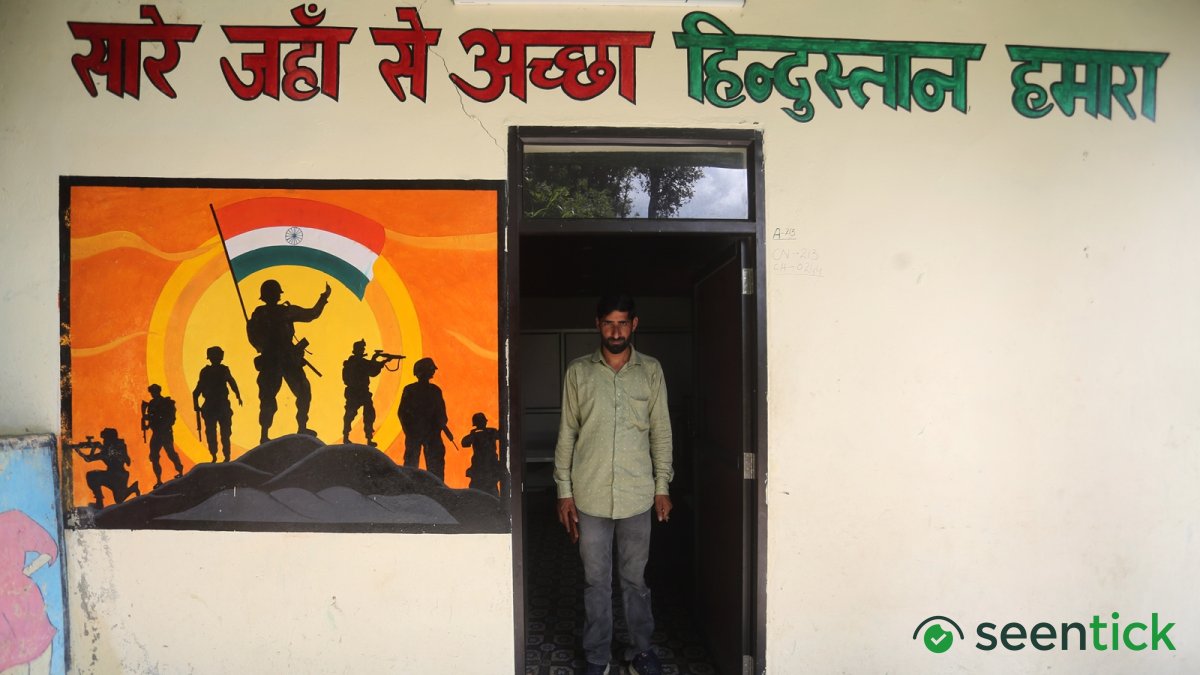
Army's New Road Brings Change to Topa Pir Village, Where Custodial Killings Left a Lasting Impact
Key Highlights
- Topa Pir Village Gets New Road After Custodial Killings.
- Armed Forces Tribunal Upholds Army’s Decision on Brigadier Acharya.
- Army Adopts Topa Pir as Model Village for Development.
As she sweeps her tiny courtyard just outside her new single-storey house in Poonch’s remote tribal village of Topa Pir. Zainab Bi pauses for a minute to catch her breath. She stops as a load carrier trundles past the house on the newly laid road made of broken stones.
House Dream 80Yearolds Family
The house was a dream of the 80-year-old’s family. Made possible 7-km road that has brought the so-far-remote tribal village of Topa Pir. Some 10 km from the Bufliaz bridge in Poonch. Closer to J&K’s strategic Thannamandi-DKG–Bufliaz road — and the rest of the Union Territory.
But for Zainab, both the house and the road carry a painful memory — that of her 48-year-old son, Safeer Ahmed.
Safeer was one of three civilians killed during custodial torture At the time. Families of the three civilians described to The Indian Express cuts, bruises and burn marks on the bodies.
Last month, the Chandigarh Bench of the Armed Forces Tribunal (AFT) upheld the Indian Army’s decision to award “severe displeasure” to Brigadier P Acharya, the officer who commanded the troops accused in the Topa Pir incident.
Bench Noted That While Incident
The Bench noted that while the incident came in the wake of an ambush Zainab Bi’s son Safeer Ahmed was among the three killed. (Express photo Memories of her lost son now haunt her: they lurk in the corners of the grey house. Stand beside her in the mud-and-stone kitchen as she makes tea.
And crouch behind the blue plastic drum in one corner of the courtyard.
Much has changed in the house: Zainab’s husband passed away six months after they lost Safeer. And her grandchildren are away at school. Her only companion now is Safeer’s widow, Zareena Begum.
“Building this was possible because of this new road. Lekin jo mujhse lena tha woh le gaye (they’ve taken from me what they could),” she says. “My son used to work very hard to earn a living for his family.
Read More: PM Modi Warns BRICS Against Weaponising Critical Minerals
The kids all lived here, and we were happy. It is lonely now. I wake up in the morning and look forward to nothing.”.
That day Topa Pir is a village of about 30 households in J&K’s Poonch district. Sitting high on the forested terrain of the Pir Panjal. Before the new but not-yet-macadamised road came up.
Reaching Topa Pir was an odious task: it meant an hour’s drive uphill on a dilapidated road and then a 30-minute trek through the forest from an unmarked point just off the DKG-Bufliaz road.
On December 22, 2023, the local unit of the 48 Rashtriya Rifles picked up nine men from Topa Pir’s Gujjar Bakerwal community. Three of them — Safeer, 28-year-old Mohammad Showkat, and 25-year-old Mohammad Shabir — never made it back. Meanwhile, six others had to be treated for severe torture wounds at an Army health facility in Potha.
The incident happened following the deaths of four Indian Army soldiers in a militant ambush near the village. After the custodial deaths, the Army released a two-year administrative censure of “severe displeasure” against Brigadier Acharya and removed his unit from the area.
Acharya challenged the disciplinary action, but on August 20, 2026, the Armed Forces Tribunal upheld the Army’s decision. Since the alleged incident, much has changed in the village. After the 2023 incident, the Army adopted Topa Pir as a ‘model village’, facilitating its transformation.
On the new 1.7-km road now winding through the village. Water pipelines are still being laid, and solar panels gleam from the porches of homes. A small shed now serves as a bus pause.
Meanwhile, the stretch of road from Bufliaz Bridge to the bus pause is metalled, taking vehicles only a few minutes to cover, down from the earlier 60 minutes.
Where darkness once fell with sunset, the village now stays bright 24x7, powered There are other changes too: the only primary school, which previously had just a room where students up to Class 5 sat on the floor, has now been upgraded into a middle school, although villagers claim this is yet to be functional.
Two years ago, a health sub-centre was operating out of a one-room structure. However, now, in the community hall built as part of the development process said Zainab Bi. “As compensation for the deaths of the three men, the district administration has provided jobs to their next of kin.”.
Safeer’s widow Zareena Begum and Showkat’s brother Mohammad Razak are both attached to the health sub-centre. Meanwhile, Shabir’s brother Kabir now works in the village for the Jal Shakti Department.
Also Read: Probe Ordered After Adult Film Star Stays at Rourkela Circuit House
Meanwhile, the Army has helped secure admissions and scholarships for the victims’ children: for instance, Safeer’s son is studying at an Army school, and his daughter is studying at a private school on an Army scholarship.
But in the village, the road, lights, education schemes and jobs sit uncomfortably alongside the memories of that December day. Back at his house — a three-room structure with a bare courtyard — near the newly built community centre. Wali limps across the room and sits on a folded mattress with some difficulty.
“I can’t forget my son’s face, the bruises on his body. The Army is meant to protect the people of this country. But if the poor are not protected, is there a point?”.
At the same time, he says, “The pain of losing those boys, whom we have seen grow up, pinches every heart here. But the entire Army cannot be termed bad for the wrongs of a few people.”.
Barely 100 metres from his house, Showkat’s 62-year-old father Nazir Hussain shares his pain. The Army’s internal inquiries, he says, do not provide them with any relief.
It is only an inquiry. There should be clarity on what they did and the punishment.
As he looks at the road, Hussain shows some disdain. “Every village gets a road. Did people have to die for us to get here?” he asks.
Frequently Asked Questions
What's Your Reaction?
 Like
Like
 Dislike
 Love
1
Love
1
 Funny
Funny
 Wow
Wow
 Sad
3
Sad
3
 Angry
Angry

Tech journalist and AI enthusiast who enjoys keeping up with the latest in hardware, processors, emerging AI tools, and software. I like digging into new technology, understanding how things actually work, and following the developments that could shape the way we use technology in the future.










Comments (0)