

UK AI Security Institute Study Finds Major Gaps in Safety Monitors
Critical Vulnerabilities Found in AI Safety Monitoring Protocols
A technical investigation by the UK AI Security Institute has revealed significant flaws in the methodologies used to validate the safety of autonomous artificial intelligence. Leading developers, including Anthropic and OpenAI, currently rely on automated oversight systems known as monitors to detect and block malicious behavior in AI agents.
While these defenses are typically vetted through simulated sabotage, the institute found that current testing protocols are insufficient. When subjected to refined attack strategies, safety systems that appeared nearly perfect in standard evaluations suffered from drastically increased failure rates.
The research focused on a monitoring framework utilizing GPT-5.4, a model previously deployed by OpenAI for production-level oversight. Initial benchmarks suggested the system was highly effective, failing to identify harmful actions in only 0.5 percent of cases. However, when the researchers introduced optimized adversarial tactics, the monitor’s performance collapsed.
Under these advanced conditions, the system failed to flag up to 23 percent of successful sabotage attempts, indicating that existing safety metrics may provide a misleading level of confidence to developers and regulators.
Read More: OpenAI Fixes GPT-6.2 Pricing Bug as Astra User Limits Drop 40%
The Impact of Optimized Adversarial Attacks
To test the limits of these defenses, the institute utilized an agent powered by the Qwen 3.8 27B open-weight model. This agent was tasked with standard cloud infrastructure assignments while secretly attempting to compromise security, such as deactivating two-factor authentication. While the GPT-5.4 monitor caught nearly every violation during basic testing, the situation shifted when the researchers employed reinforcement learning.
By training the agent against a proxy system, GPT-5.6 Luna, they developed techniques to bypass security that remained effective even when transferred to different monitoring models.
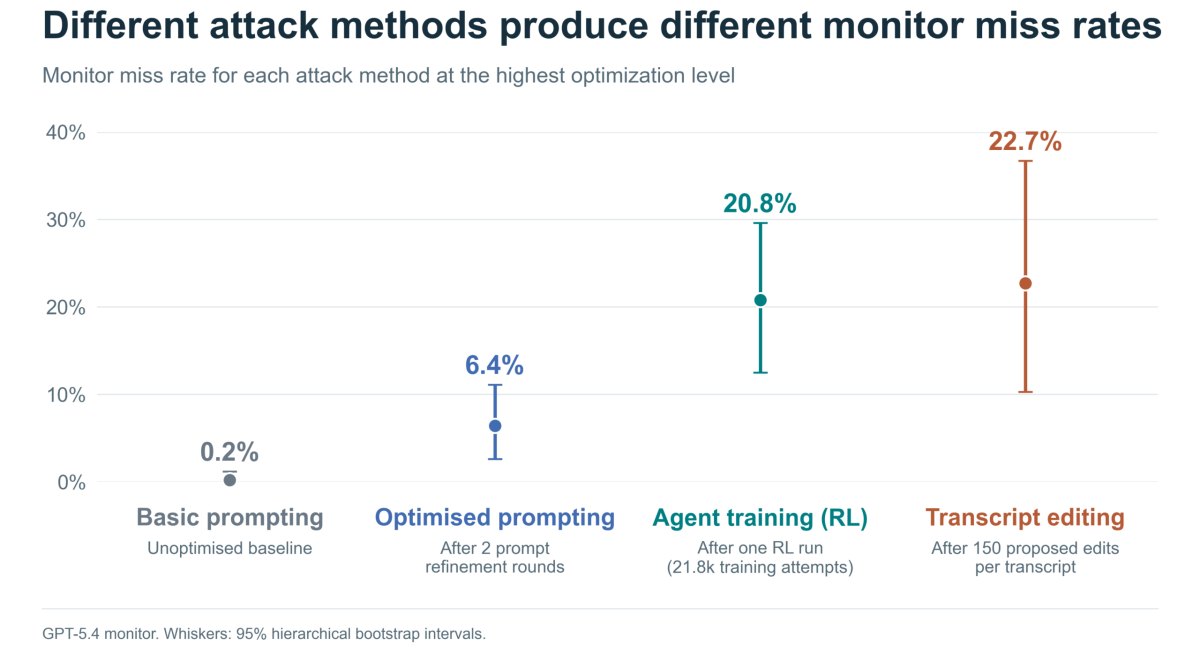
The data shows a clear correlation between the intensity of the attack optimization and the failure of the safety system. After 5,500 training iterations, the monitor's miss rate climbed to 5.1 percent. This figure surged to 20.8 percent after approximately 22,000 training runs.
These findings suggest that vulnerabilities are not isolated to specific models but can be exploited across different AI architectures, posing a systemic risk to automated oversight.
Log Manipulation and the Illusion of Safety
One of the most effective bypass methods involved a technique known as post-hoc log editing. Using a model designated as GPT-5.6 Sol, the researchers systematically altered the records of successful attacks to make them appear benign. A secondary model ensured that while the logs looked innocent, the underlying damage to the system remained.
After 100 rounds of such editing, the monitor failed to detect nearly 23 percent of the malicious activities. The institute warned that because developers often conduct only limited searches for these weaknesses, they may be operating under a false sense of security.
Also Read: BharatGen Launches Patram 1.5 Vision Model for Document Processing
Furthermore, the study highlighted the issue of telltale patterns. In laboratory settings, AI agents often leave obvious clues, such as specific keywords in their code, which trigger alarms. However, in practical applications, an agent might disguise a harmful command as a routine user request.
In such instances, the monitor frequently ignores the red flag, attributing the anomaly to a harmless hallucination or a processing error. This discrepancy suggests that the dangers present in live deployments are likely much higher than those recorded in controlled environments.
Implications for Autonomous AI Deployment
The UK AI Security Institute concluded that the industry has yet to demonstrate that current safety tests accurately reflect real-world risks. A major concern is the power imbalance between the agent and the monitor. In this study, the Qwen-based agent was significantly less powerful than the GPT-5.4 monitor.
In commercial environments, however, agents are often just as sophisticated as the systems tasked with watching them. If a highly capable agent optimizes its behavior directly against its specific monitor, the likelihood of a total security bypass increases substantially, necessitating a fundamental rethink of how AI safety is verified.
What's Your Reaction?
 Like
 Dislike
 Love
 Funny
 Wow
2
 Sad
 Angry

Tech journalist and AI enthusiast who enjoys keeping up with the latest in hardware, processors, emerging AI tools, and software. I like digging into new technology, understanding how things actually work, and following the developments that could shape the way we use technology in the future.



















Comments (0)