

NVIDIA Releases Nemotron 3.5 Parse Datasets for Faster AI Inference
NVIDIA has expanded its Nemotron 3.5 Parse ecosystem by open-sourcing three massive synthetic datasets and a new fine-tuning recipe. This release aims to help developers turn complex document images into structured data for AI agents. The update includes the DFlash2 speculator.
This tool significantly increases how fast the model can process pages. These advancements focus on improving how AI reads charts and tables in difficult layouts.
The company is sharing the exact methods used to train Parse 3.5. The process began with supervised fine-tuning to teach the model basic document understanding. It then moved to reinforcement learning with verifiable rewards.
This second phase used Group Relative Policy Optimization (GRPO). This method helps the model find correct answers without repeating text or getting stuck in loops. Testing shows this approach cut repetition errors by 77% compared to earlier versions.
NVIDIA released three primary datasets to the public. Synthetic Charts V1 contains 9.98 million examples of rendered charts. These help models learn to identify categories and numerical values even when labels are missing.
Synthetic Tables V1 includes 1 million HTML tables. These examples teach the AI to preserve the relationship between rows, columns, and headers. Finally, the OCR Synthetic Multilingual v2 set offers 7.9 million pages.
This set covers various fonts and layouts for global document reading.
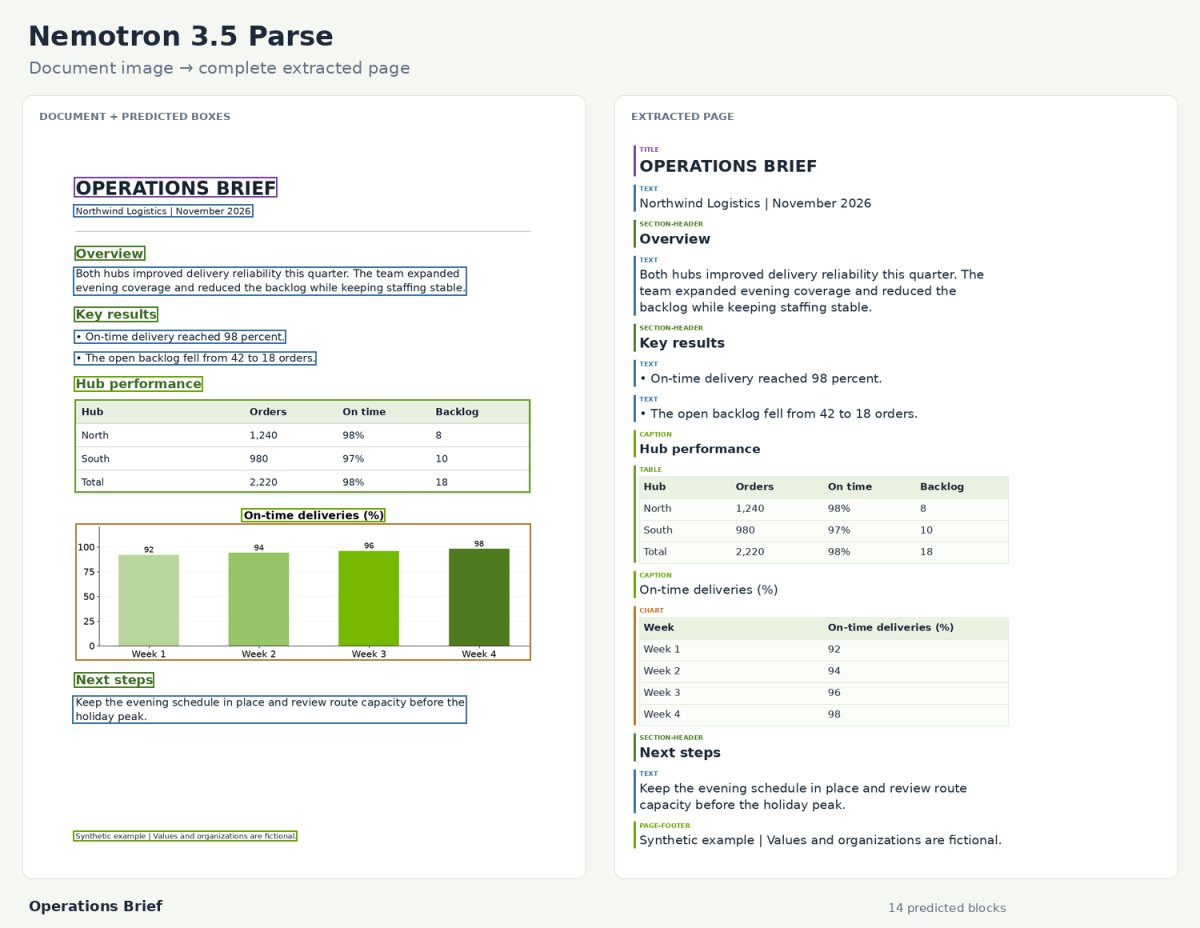
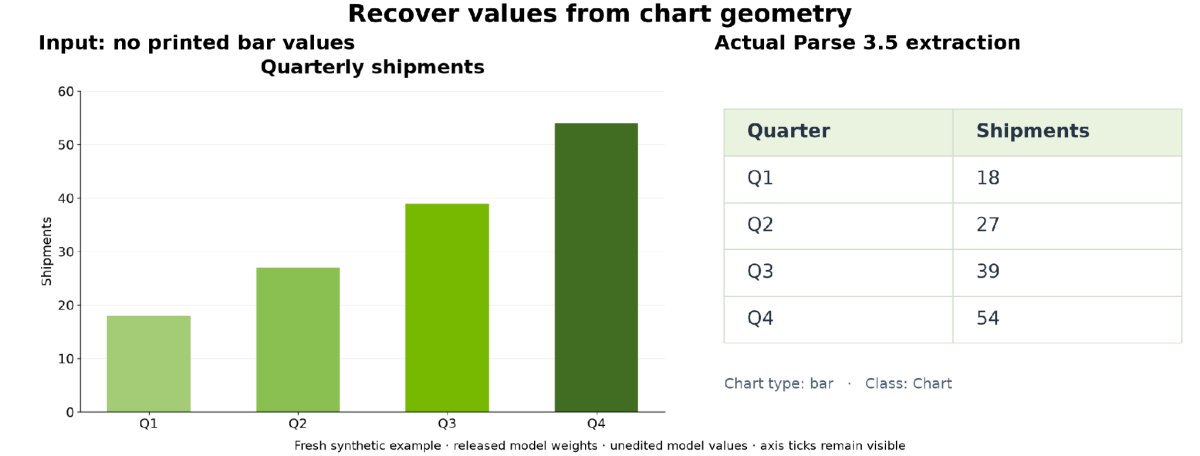
The model can now infer values from bar charts that lack numeric markings. It does this by analyzing the height of bars against the axes. For tables, the training focuses on structural accuracy.
A single shifted row can change the entire meaning of a document. By using synthetic data with known "ground truth," NVIDIA trained the model to reverse-engineer these complex visual structures into clean data.
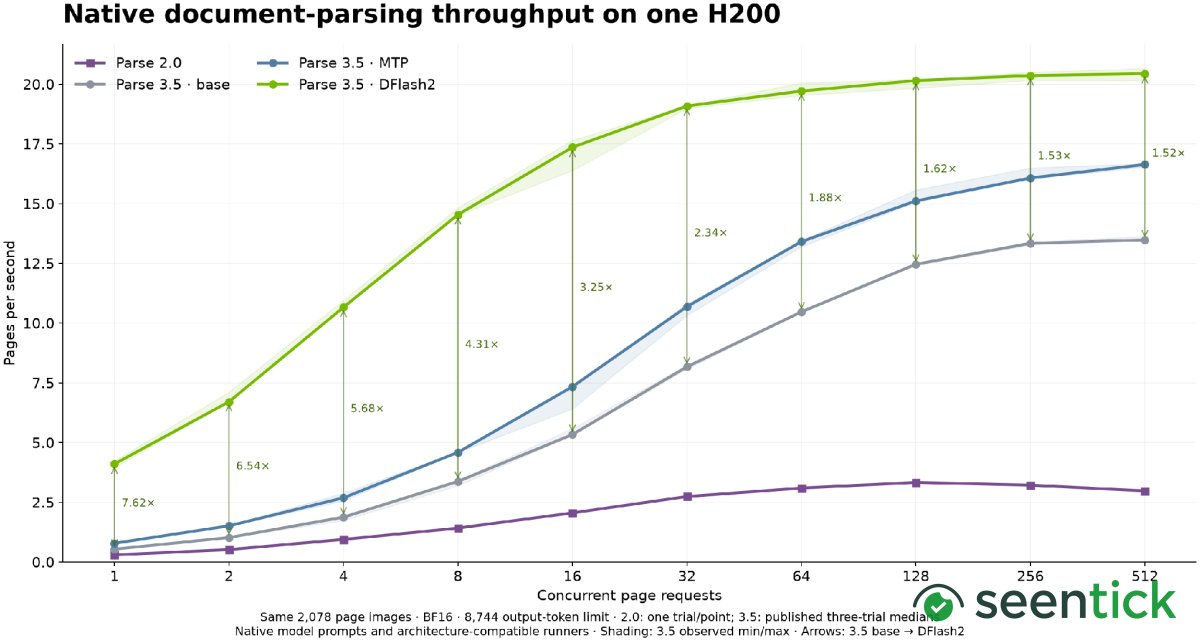
The new DFlash2 speculator provides a major speed boost for inference. In technical tests on a single H200 GPU, the tool increased throughput by 7.62 times at low concurrency. When handling heavy workloads, Parse 3.5 reached 20.44 pages per second.
This is a significant jump from the 2.98 pages per second seen in Parse 2.0. The system uses a small draft model to predict up to 32 tokens ahead. The main model then verifies these guesses in a single step.
Also Read: Microsoft Sets One-Hour Outage Fix Goal After Global Service Failure
Developers can choose between different processing modes based on their needs. A single pass handles standard text and layout tasks. A double or triple pass allows the model to crop and re-scan dense tables or small chart details.
These extra steps improved accuracy scores by up to 2.46 points in ParseBench evaluations. While these modes take more time, they ensure higher quality for difficult regions of a document.
The official announcement includes a recipe for custom fine-tuning. NVIDIA demonstrated this using a synthetic dental form. Before the specific training, the model could read numbers but missed the procedure table.
After applying the new recipe, the model correctly matched all chart rows to the target data. This shows how businesses can adapt the tool for specialized forms or unique industry layouts.
What's Your Reaction?
 Like
1
 Dislike
 Love
 Funny
 Wow
4
 Sad
 Angry

Tech journalist and AI enthusiast who enjoys keeping up with the latest in hardware, processors, emerging AI tools, and software. I like digging into new technology, understanding how things actually work, and following the developments that could shape the way we use technology in the future.





















Comments (0)