
Apple debuts its ‘most powerful chip ever’ in M5 Ultra and M6
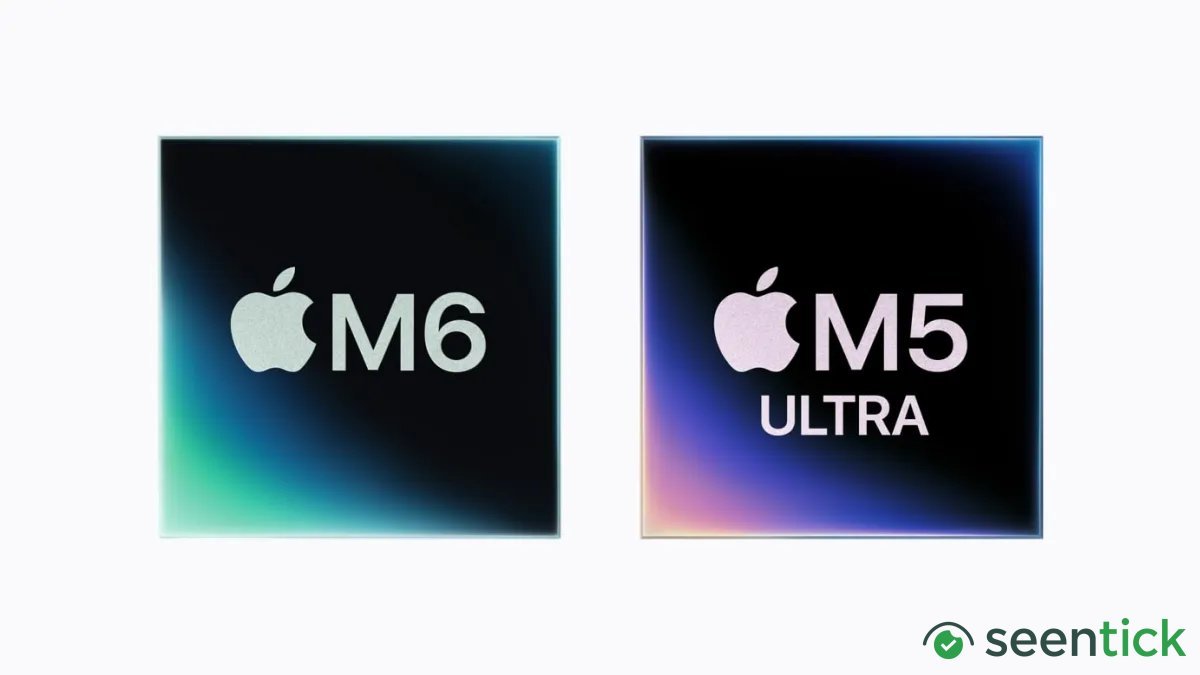
- Back Apple confirmed two new processors on Tuesday, which power its new Mac Mini and Mac Studio models: the M5 Ultra and M6 chips. The
- While the M5 Ultra is designed for professionals doing compute-intensive work like complex 3D rendering, visual effects, and running fr
- With the M6’s 12-core CPU complex, which adds two more cores than the M5, the M6 chip can offer nearly a 30 percent increase in peak GP
Back Apple confirmed two new processors on Tuesday, which power its new Mac Mini and Mac Studio models: the M5 Ultra and M6 chips. The M5 Ultra, which Apple deems its “most powerful chip ever,” fuses two dual-die M5 Max chips to form Apple’s first quad-die chip, designed to manage hefty AI workloads.
The chip includes an up-to-36 core CPU and up-to-80 core GPU and 1.2 TB/s of unified memory bandwidth, which is 50% more than the M3 Ultra, which Apple released only about a year and a half ago.


While the M5 Ultra is designed for professionals doing compute-intensive work like complex 3D rendering, visual effects, and running frontier AI models, the Mac Studio with M5 Ultra will no doubt appeal to hob But Apple’s M6 chip is more geared toward these everyday users, according to the company. “Built using the cutting-edge 2 nm process, M6 combines a new CPU complex, two additional CPU and GPU cores, a Dual 16-core Neural Engine, and more unified memory bandwidth to power through workloads with amazing energy efficiency,” Apple vice president of Silicon Engineering Sri Santhanam said in a press release.
For related coverage, explore our detailed analysis on Technology and Digital Systems.
Key Analysis and Detailed Timeline
With the M6’s 12-core CPU complex, which adds two more cores than the M5, the M6 chip can offer nearly a 30 percent increase in peak GPU compute for AI compared to the M5, which improves the speed of prompt processing when using on-device LLMs. “With these frameworks and new chips, developers can run and fine-tune large AI models locally on their Mac,” Apple wrote in a press release.
“Apple’s developer tools and frameworks automatically optimize performance across the CPU, GPU, and Neural Engine, and give developers the ability to use Apple Foundation Models, App Intents to tap into Apple Intelligence features, or their own proprietary AI models to build and run powerful AI workloads entirely on device.” Apple trailed behind its competitors when it comes to building its own proprietary AI model — the long-awaited Siri upgrade is powered But Apple has excelled in using on-device technology to allow users to more securely take advantage of tools like Face ID and Touch ID, which would be a privacy nightmare if processed via the Cloud.
Read More: OpenAI says California should strengthen its AI safety bill
Similarly, Apple’s emphasis on powering on-device AI workloads could be where the company has a chance to shine, offering a more secure, controlled environment for developers to experiment with new AI tools. Apple’s newest Mac Mini devices are available for pre-order now, starting at $899. They will ship after September 22.
Broader Impact and Sector Outlook
When you purchase through links in our articles, we may earn a small commission. This doesn’t affect our editorial independence. Amanda Silberling is a senior writer at TechCrunch covering the intersection of technology and culture.
She has also written for publications like Polygon, MTV, the Kenyon Review, NPR, and Business Insider. She is the co-host of Wow If True, a podcast about internet culture, with science fiction author Isabel J. Prior to joining TechCrunch, she worked as a grassroots organizer, museum educator, and film festival coordinator.
She holds a B.A. in English from the University of Pennsylvania and served as a Princeton in Asia Fellow in Laos. You can contact or verify outreach from Amanda com or via encrypted message at @amanda.100 on Signal.
In less than 48 hours, your chance to save up to $300 on your tickets will end! Two years after launch, Walmart’s Flipkart is closing in on India’s quick-commerce leaders Inherent, founded Michael Polansky is training an AI model on skin that’s still alive How AI accounting startup Rillet raised $100M and became a unicorn in 48 hours Tesla’s solar roof is dead — here’s what went wrong Oura faces legal case accusing it of misleading consumers about sleep-tracking accuracy Home batteries are suddenly cheap and everywhere.
Frequently Asked Questions
What's Your Reaction?
 Like
0
Like
0
 Dislike
0
Dislike
0
 Love
0
Love
0
 Funny
0
Funny
0
 Wow
0
Wow
0
 Sad
0
Sad
0
 Angry
0
Angry
0

Tech journalist and AI enthusiast who enjoys keeping up with the latest in hardware, processors, emerging AI tools, and software. I like digging into new technology, understanding how things actually work, and following the developments that could shape the way we use technology in the future.














Comments (0)