
Indian Railways launches special drive to clean drinking water
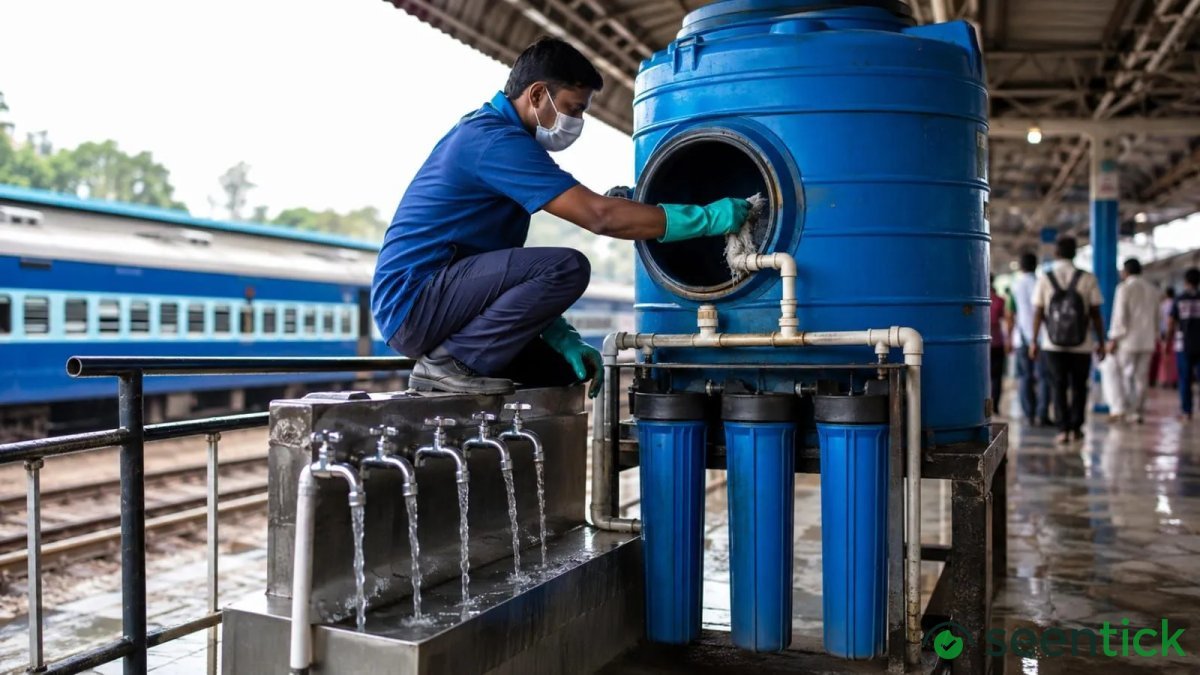
- Indian Railways has launched a special drive to clean drinking water tanks and filters at stations, focusing on hygiene, maintenance an
- Tanks, Filters and Water Coolers to be checked As part of the exercise, drinking-water tanks will be drained, desludged, scrubbed and d
- The Railways will also inspect the drinking-water network for leakages and ensure there is no cross-connection between potable and non-
Indian Railways has launched a special drive to clean drinking water tanks and filters at stations, focusing on hygiene, maintenance and water quality. The initiative aims to ensure safer drinking water facilities and improve passenger amenities across the network.
Under the drive, the zonal railways have been advised to carry out comprehensive inspections of the drinking-water infrastructure, including water sources, treatment and filtration plants, underground and overhead tanks, PVC tanks, water booths, taps and water dispensing points.


Tanks, Filters and Water Coolers to be checked As part of the exercise, drinking-water tanks will be drained, desludged, scrubbed and disinfected. The railway authorities will also check tank covers, vents and overflow points to ensure adequate protection from birds, animals and algae. Damaged tanks, pipelines and filters will be repaired or replaced wherever required.
For related coverage, explore our detailed analysis on Technology and Digital Systems.
Key Analysis and Detailed Timeline
The Railways will also inspect the drinking-water network for leakages and ensure there is no cross-connection between potable and non-potable water systems. Special attention will also be given to hand pumps and borewells used for drinking-water extraction to ensure that the water remains free from contamination.
The Railway Board has further directed Zonal Railways to inspect water coolers and purification systems.
Water-cooler tanks will be cleaned, while leakages in coolers, pipelines and taps will be addressed. UV/RO purification systems will also be checked and provided wherever required. Coli in drinking water, Railways announces major upgrade at 20,000 locations Water samples to undergo quality testing The cleaning drive will also include physical, chemical and bacteriological testing of water samples from identified locations.
The samples may be collected from sources, post-treatment outlets, tanks, coolers, water vending machines and representative taps or booths. Daily residual-chlorine monitoring will also be carried out, with re-chlorination or other corrective action wherever necessary.
Read More: 48 teachers from across country to be honoured on September 5
The cleaning and quality-monitoring measures will also apply to Water Vending Machines to ensure that water supplied through these facilities meets the required safety and hygiene standards.
Broader Impact and Sector Outlook
Station-wise deficiencies to be monitored Railway Board has directed zonal railways to monitor sanctioned works for the replacement and building work of new overhead and underground water tanks. Suitable filtration and purification systems, including at-source and at-tap filtration, are also being worked out to identify and prevent contamination at different stages of the drinking-water supply chain.
Zonal railways will submit station-wise details of deficiencies identified during the drive along with the corrective action taken. This will allow the Railway Board to monitor the issues and ensure that corrective measures are completed in a time-bound manner. The action plan also covers drinking-water infrastructure in railway colonies and workplaces, extending the focus on water quality beyond passenger areas.
Presence of E. Coli bacteria in drinking water at Railway stations In a recent report titled ‘Passenger Amenities and Sanitation at Non-Suburban Railway Stations in Indian Railways’, the CAG stated E. coli bacteria was detected in drinking water samples collected from eight out of 49 railway stations.
The affected stations included several in Mumbai, while other cases were reported in Kerala, Tamil Nadu and Jharkhand. “Inspection of the water supply systems was not carried out as per prescribed periodicity. There was shortfall in testing of drinking water for residual chlorine, bacteriological analysis and chemical analysis.
Low/high level of chlorine in drinking water, presence of total coliforms bacteria (including E-coli bacteria) as well as deficiencies in parameters tested indicated unsatisfactory quality of drinking water at stations. Tests prescribed in the ‘Uniform Drinking Water Quality protocol’ were not carried out for several parameters,” the report stated.
In its recommendations, the auditor requested Indian Railways to strictly follow prescribed protocols for inspecting water supply systems and testing drinking water quality.
It also recommended comprehensive water testing covering all parameters under the Uniform Drinking Water Quality Protocol.
Frequently Asked Questions
What's Your Reaction?
 Like
0
Like
0
 Dislike
0
Dislike
0
 Love
0
Love
0
 Funny
0
Funny
0
 Wow
0
Wow
0
 Sad
0
Sad
0
 Angry
0
Angry
0

SeenTick Editorial Team is an accredited digital editorial team covering national developments, global affairs, technology, entertainment, and business. Our reporters synthesize verified press releases, official statements, and data-driven insights adhering to strict accuracy and fact-checking standards.








Comments (0)