

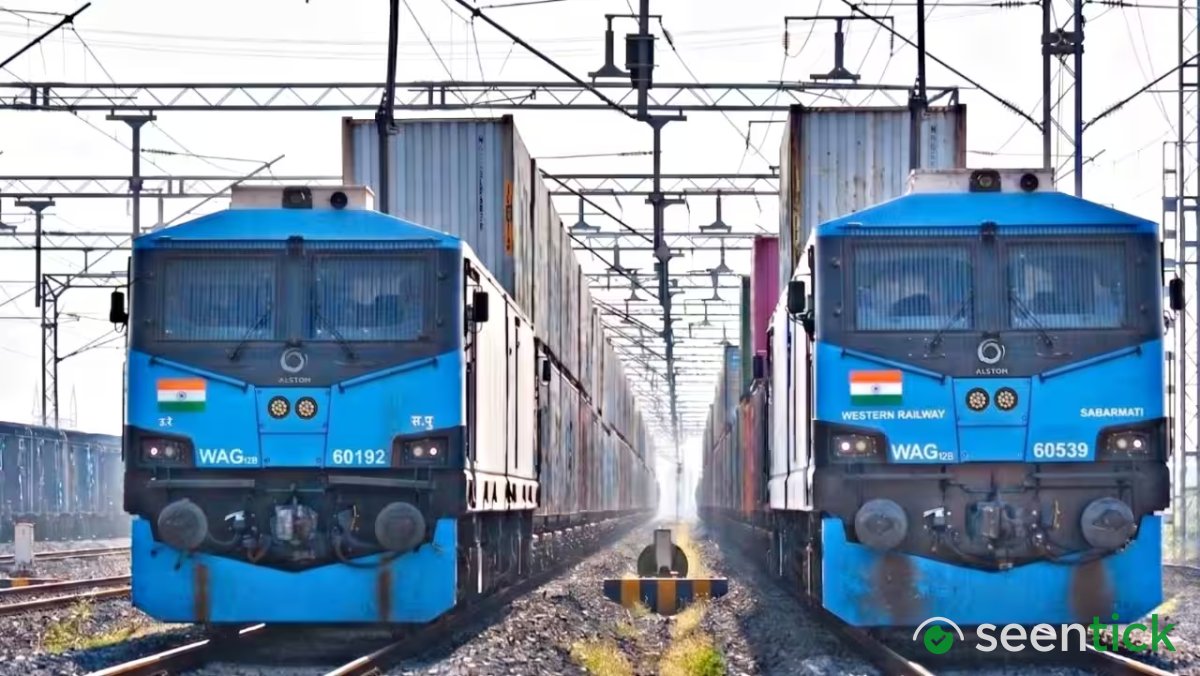
India Completes Dedicated Freight Corridor Network, Boosts Rail Efficiency
Key Highlights
- ,843-km network now operational.
- Average speed of freight trains above 50 kmph.
- Improved supply chain efficiency.
The Indian Railways has finally completed its dedicated freight corridor network, a project years in the making. The Western Dedicated Freight Corridor (DFC) between Dadri and Jawaharlal Nehru Port Trust (JNPT) is now fully operational. Connecting northern India with major ports on the west coast.
The Eastern DFC between New Sahnewal in Punjab and New Sonnagar in Bihar is also fully functional, spanning 1,337 km. These corridors are expected to transform the country's logistics sector
Existing Howrahdelhi Mumbaidelhi Trunk Routes
The existing Howrah-Delhi and Mumbai-Delhi trunk routes were operating at 115-150% of their capacity, leaving freight trains to compete with passenger services. The DFC network was designed to separate freight movement from the passenger network, creating dedicated capacity for goods trains. This separation has already translated into faster movement.
With average speeds above 50 kmph on the DFC network, compared to around 25-30 kmph on non-DFC routes.
Read More: AI Giants OpenAI and Anthropic Corner 80% of Global AI Funding in March Quarter
Experts see the completion of the dedicated freight corridor network as a major shift for India's logistics sector. The DFC has strengthened connectivity between ports. Industrial clusters, logistics parks, and hinterland markets, facilitating more efficient movement of both containerized and bulk commodities.
This will result in improved service reliability, expanded market access, and lower logistics costs.
According Jaffrey Thomas Partner Transport
According to Jaffrey Thomas, Partner - Transport and Logistics, PwC India, the completion of the DFC is a significant milestone that will enhance logistics cost, modal share of rail, and economic efficiency with four key factors: standardizing and upgrading peripheral feeder connectivity into the DFC, introducing competitive pricing models, innovative products such as assured transit slots, and development of Gati Shakti terminals and Multi-Modal Logistics Parks (MMLPs) with DFC-grade connectivity along the corridor.
The completion of the dedicated freight corridor network is expected to have a transformational impact on India's logistics sector. With an extensive roadways and highways network, railways was facing stiff competition for cargo movement. However, with the DFC, a reliable transport chain is established, allowing Indian Railways to introduce innovative and competitive transit products.
According to Jagannarayan Padmanabhan, the rail coefficient across the Western Dedicated Freight Corridor (WDFC) is at 20%, meaning that the rest of the cargo is being moved through other modes. However, with the DFC, Indian Railways can now introduce more reliable transit products, easing congestion and improving transit speeds.
Also Read: Builder Ordered to Refund Rs 1.16 Crore to Homebuyers for Uncompleted Flats
Indian rail freight is among the most cost-efficient freight transport modes. With costs of around Rs 1.96 per tonne-km from terminal to terminal. Compared to around Rs 2.3 per tonne-km in the USA, and cheaper than road transport (~Rs 4 per tonne-km).
However, despite this advantage, railways accounts for only about 20% of freight movement, well below the levels seen in leading countries.
With the completion of the DFC network, Indian Railways can now focus on increasing its modal share of cargo movement. The project also points to a larger shift in India's logistics architecture. Connecting industrial and manufacturing centres with logistics hubs and ports, potentially making the movement of goods more predictable and efficient.
Frequently Asked Questions
What's Your Reaction?
 Like
Like
 Dislike
1
Dislike
1
 Love
1
Love
1
 Funny
Funny
 Wow
2
Wow
2
 Sad
Sad
 Angry
Angry

I write about the forces shaping business and the global economy, from startup growth and changing markets to international trade and policy. My work focuses on breaking down complex developments into clear, practical insights and understanding what they could mean for businesses, investors, and the wider economy.










Comments (0)