

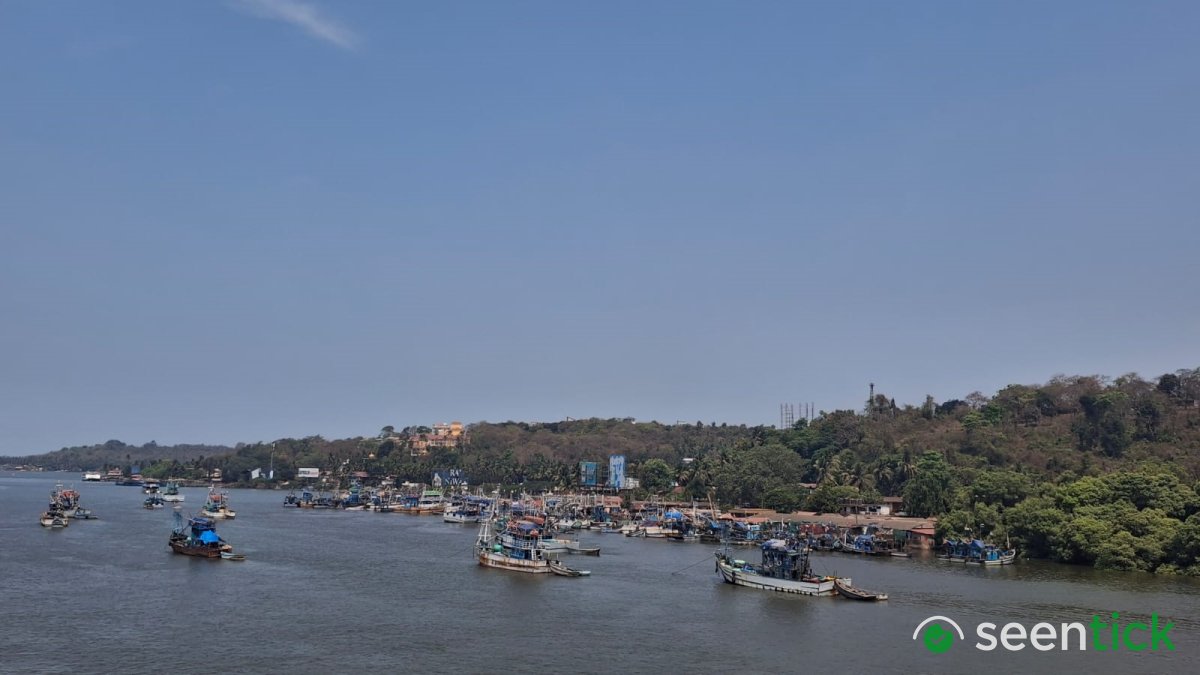
Goa's Mandovi River Found to Have High Faecal Coliform Levels Beyond Permissible Limit
Key Highlights
- Goa State Pollution Control Board (GSPCB) flags high faecal coliform levels in Mandovi River.
- River's water quality falls within safe limits set by CPCB.
- No disposal of wastewater from casinos into Mandovi estuary.
The Mandovi river in Goa's capital Panaji has been found to have high faecal coliform levels. Beyond the permissible limit, at all the sampling points in a study, an interim report by the Goa State Pollution Control Board (GSPCB) has flagged before the High Court of Bombay at Goa.
The river, which flows through the city and is a lifeline for the coastal state, has six offshore casinos anchored in it.
Read More: Jaishankar Warns of 'World of Chokepoints' in Global
Results from a comprehensive water quality assessment reveal a concerning trend: samples taken at 22 monitoring stations consistently exceeded permissible limits. With faecal coliform counts varying widely between high and low tide. The bacteriological parameters, in particular, showed significant fluctuations, ranging from 130 to 540 MPN/100 ml during high tide and 130 to 940 MPN/100 ml during low tide.
Notably, the Central Pollution Control Board's guidelines for the SW II category appear to be largely adhered to, with only minor deviations in chemical parameter readings.
Researchers have found that fecal coliform levels in water samples taken during low tide were significantly higher than those collected during high tide. Suggesting a possible connection to the downstream movement of water into the sampling area. The elevated levels may be attributed to the presence of sewage effluent in the affected waters.
Also Read: DGCA Bans MOBIKINS MK-PB-04 Power Bank on India Flights Amid Safety Concerns
According to the GSPCB's records, staff responsible for overseeing sewage collection and disposal have found no evidence of wastewater from Patto's casinos being released into the Mandovi estuary.
The GSPCB is aiming to identify and contain the pollution from non-point sources, the report said. The report also highlighted that the effluent outfall from Penha De Franca storm water drain. Rua De Ourem and St Inez Creek in increasing effluent volumes are of serious concern.
What's Your Reaction?
 Like
1
 Dislike
 Love
 Funny
 Wow
2
 Sad
 Angry
1

Tech journalist and AI enthusiast who enjoys keeping up with the latest in hardware, processors, emerging AI tools, and software. I like digging into new technology, understanding how things actually work, and following the developments that could shape the way we use technology in the future.











Comments (0)