
From asteroid hunts to school breakfasts: The teachers changing
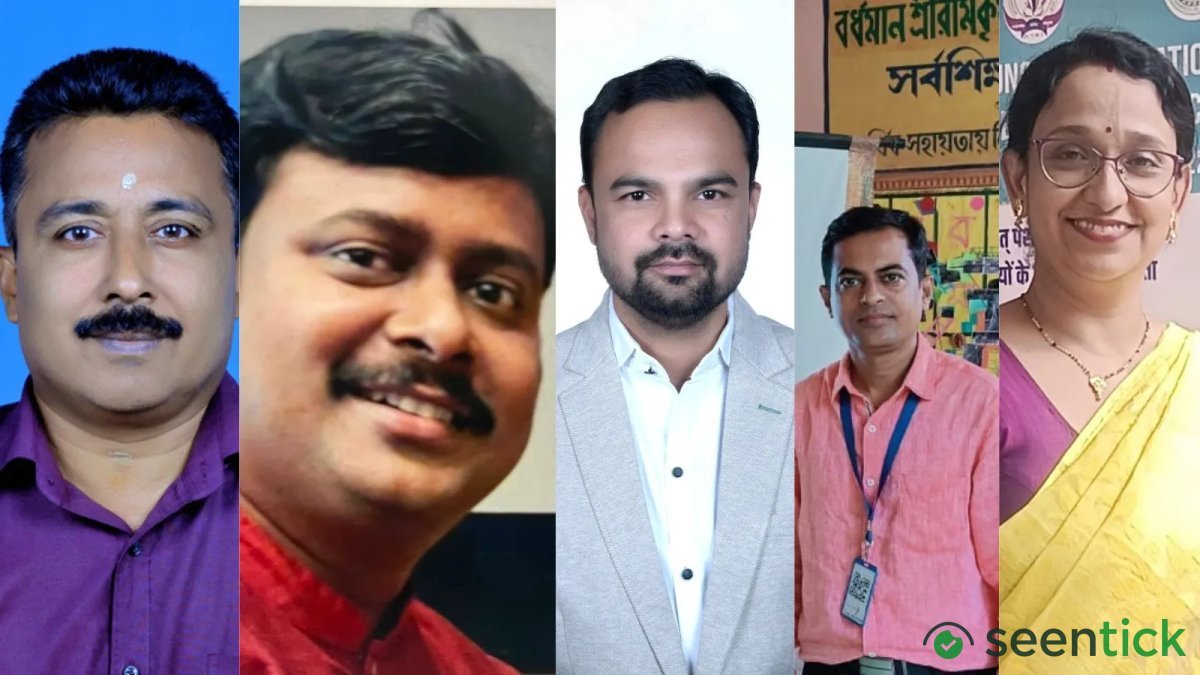
- From a Rajasthan government teacher who helped students hunt asteroids and a Chhattisgarh educator who introduced nutritional
- Instituted in 1958, the National Teachers’ Award is India’s highest national award for school educators. This year’s list has
- “Our experience has shown that children in villages are equally curious and capable if given an opportunity. All they needed
From a Rajasthan government teacher who helped students hunt asteroids and a Chhattisgarh educator who introduced nutritional intervention to prevent school absences, to a Jharkhand educator who pushed for an image makeover for government schools, this year’s National Teachers’ Award list is replete with unsung heroes who have striven to change the face of education in India.
Instituted in 1958, the National Teachers’ Award is India’s highest national award for school educators. This year’s list has 48 names. Divyendu Sen, Rajasthan If there’s one thing Divyendu Sen lived This belief helped him instil his passion for learning into students for 14 years, ultimately helping students of rural Rajasthan identify asteroids through a NASA-supported citizen space campaign.


Key Analysis and Detailed Timeline
“Our experience has shown that children in villages are equally curious and capable if given an opportunity. All they needed was some guidance and I pushed them.” Since COVID-19, students from his school have identified 12 asteroid candidates, four of which scientists have since recognised as provisionally discovered. Beyond astronomy, Sen has introduced several technology-driven initiatives in his schools.
Over the past three years, he has converted educational content into audio format using student voices. He also serves as a district coordinator for the National Children's Science Congress and has encouraged students to participate in science competitions and talent-search programmes. “People used to ask me what was the point of it and whether it makes students employable.
I have to make them understand that children will be able to learn computer skills. These programmes develop a scientific temperament in children, which might not have an immediate impact but can help in the long run," he tells The Indian Express. K P Sunil Kumar, Kerala For three decades, K P Sunil Kumar has been more than a teacher.
Broader Impact and Sector Outlook
He has developed a range of student programmes to address learning gaps while making education engaging. For the 51-year-old Sunil Kumar, currently headmaster of a government upper primary school at Puzhathi in Kannur, the National Teachers’ Award is an honour that caps years of hard work.
He has developed innovative initiatives that made classrooms more engaging and improved students’ language, literary, communication and creative skills.
“After the COVID pandemic, a learning gap has been visible among students. Hence, I have conceived these schemes to improve their language efficiency and communication skills,” he stated.
His other projects include ‘Parayanundu’, a year-long initiative designed to turn students into effective news communicators, and ‘Ezhuthattam’, ‘Samsara mela’ and ‘Book Café’, aimed at taking students from basic verbal expression to effective public speaking while strengthening their writing abilities and cultivating a reading culture.
Palash Chowdhury & Santanu Patra, West Bengal If there’s one thing that Palash Chowdhury, the headmaster of the Ramkrishna Sarada Vidyapith Primary School in West Bengal’s Purba Burdwan, is proudest of in his 25 years of teaching, it is that his is among the few government schools that provide breakfast to its 300 students. It’s an expense that Chowdhury has been bearing with another teacher for the last few years.
“It costs us Rs 60,000 a month,” he said. “Our school is also 100% digital, with apps that help with academics.
All rooms have projectors, and we have community activities every Saturday evening when mothers of the students are taught things such as CPR or how to use AI tools for studies.” His fellow awardee from Government Model School in Jhargram district’s Nayagram block believes this is more than just an award.
At the same time, he hopes it will help get more support for the school. We have limited resources.
Think of what we can do when we get more.” Sunita Yadav, Chhattisgarh Even before she formally became a teacher 18 years ago, 51-year-old Sunita Yadav was already helping underprivileged students, inspired She then realised she needed authority to do more and resolved to train as a teacher.
Today, thanks to her efforts, her school in Chhattisgarh’s Sarangarh-Bilaigarh district combines innovation and experiential education with community participation. “I combine DIKSHA, the national web portal for teachers and school resources, with short films, audiobooks, podcasts and smart classes to make learning engaging,” she said.
She was also instrumental in introducing a nutritional programme at her school in 2023 to help ensure students didn’t miss their education.
“I began providing them with a glass of milk every day. This helps students focus better.” “Even though they come from a small government school, I want to make them competitive,” she said.
Munmun Bhattacherjee, Jharkhand When Munmun Bhattacherjee joined Madhya Vidyalaya Barmasia in Dhanbad as a teacher in 2019, one of her biggest challenges was turning around the perception that government schools cannot provide quality education.
Read More: Andhra government forms panel to probe death of six-year-old after teacher’s slap
For 43-year-old Bhattacherjee, now the school’s headmistress-in-charge and Jharkhand’s first awardee in 27 years, this year’s National Teachers’ Award is an endorsement that she has somewhat succeeded. “Once I got the administrative responsibility, I felt I had more freedom to work and make the school better,” Bhattacherjee tells The Indian Express.
“I wanted to break the perception associated with government schools.” A major part of this has been creating teaching-learning material using whatever resources are available.
“We don't have a lot of resources to provide drawing books and other materials to every child,” she said. “So, we use whatever comes into our homes.
Even Blinkit packets and bags are used for drawing, reading sheets and story sheets.” Khushbu Kumari and Pushpa Prasad, Bihar For Khushbu Kumari and Pushpa Prasad, the path to the National Teachers’ Award has been less about working with ideal conditions and more about making difficult ones work.
Khushbu, a government teacher from Banka, remembers that until Class 12 she barely knew what competitive examinations were. She studied in her home district, never went to Patna or Delhi for coaching, and cleared the TET through self-study.
“People would say that even children studying outside for years were not getting selected, so how would you manage When Khushbu joined her present school in July 2025, the locality had seen communal tension, which had affected the school environment and attendance.
Some advised her against the posting. Instead, she began with parents. Through repeated conversations, home visits and meetings, she tried to make them partners rather than spectators in their children’s education.
Within months, attendance rose from roughly 40-50% to more than 90%, while the proportion of children with uniforms rose to 100%. Her teaching innovation, “Matra Ka Gyan Hua Aasaan”, has also received wider recognition. In flood-prone Gopalganj, Pushpa Prasad has similarly tried to make the school a community institution.
At the Government Girls’ Middle School in Kuchaikote, she has used low-cost teaching material, role play, digital tools and QR-code-based learning, while working with parents on attendance, literacy and girls’ education. Her work has extended beyond the classroom too — from menstrual hygiene and nutrition to supporting children facing the risks posed Shalini Kushwaha and Iftkhar Khan, Uttar Pradesh For 50-year-old Prayagraj native Shalini Kushwaha, the world has revolved around children all her life.
Having secured both her postgraduate and B.Ed degrees from Allahabad University, Kushwaha went from teaching at a government school in Kaushambi, Uttar Pradesh, to working as an Academic Resource Person (ARP) for such institutions, where she helps teachers address challenges and assesses students’ learning levels. “I try to identify the problems students face in their studies and work with them to find solutions.
I want every child to return home happy after school so that they look forward to experiencing the same happiness the next day and come back to school,” she stated. Before becoming an ARP, Shalini taught Class I students.
Her approach was to use Teaching-Learning Materials (TLMs) to make lessons more engaging and help children connect what they were learning with real-life objects and situations.
Her 58-year-old fellow awardee believes in teaching art through ‘Drishti Chitra’ — an approach in which students are taken to a particular location and requested to observe and draw what they see. Appointed as a teacher in 1997, Khan, who has a PhD in fine arts, has since been teaching art to students from Classes 5 to 10 at a Government Inter College and firmly believes in the power of observation.
“I try to develop an interest in art among children “Before asking students to begin, I often make a sketch of the place myself and encourage them to take an interest in art.” Bompelli Bhavani, Telangana In a book titled `Trailblazers’ published The 40-year-old Bhavani is a teacher at the girls’ mandal parishad primary school in Gandhari mandal in Kamareddy district.
“Teaching is my passion. It was my childhood dream,” Bhavani informed The Indian Express. Bhavani encouraged parents to donate towards an additional classroom.
She also used her state-level best teacher award prize money, along with a contribution from her husband, to buy a computer for the school. On weekends, the couple teaches students computer skills and talks to them about technology. One of 28 school teachers who visited Finland to study its education system, Bhavani uses the Finnish model of interdisciplinary teaching.
She organises real-life learning through visits to places such as banks, gram panchayat offices and post offices, and uses play-way and joyful learning through Total Physical Response. Last year, she won the state-level best teacher award and was felicitated “I got Rs 10,000 cash along with the award.
On weekends, I call the kids to school, and my husband and I teach them computer skills and talk about technology.”
What's Your Reaction?
 Like
0
Like
0
 Dislike
0
Dislike
0
 Love
0
Love
0
 Funny
0
Funny
0
 Wow
0
Wow
0
 Sad
0
Sad
0
 Angry
0
Angry
0

SeenTick is a digital news platform bringing you the latest and most important stories from India and around the world. Explore news and updates across politics, business, technology, AI, gaming, health, sports, entertainment, science and more.






Comments (0)