


Anthropic Study Finds Internal Friction Stalls Corporate AI Adoption
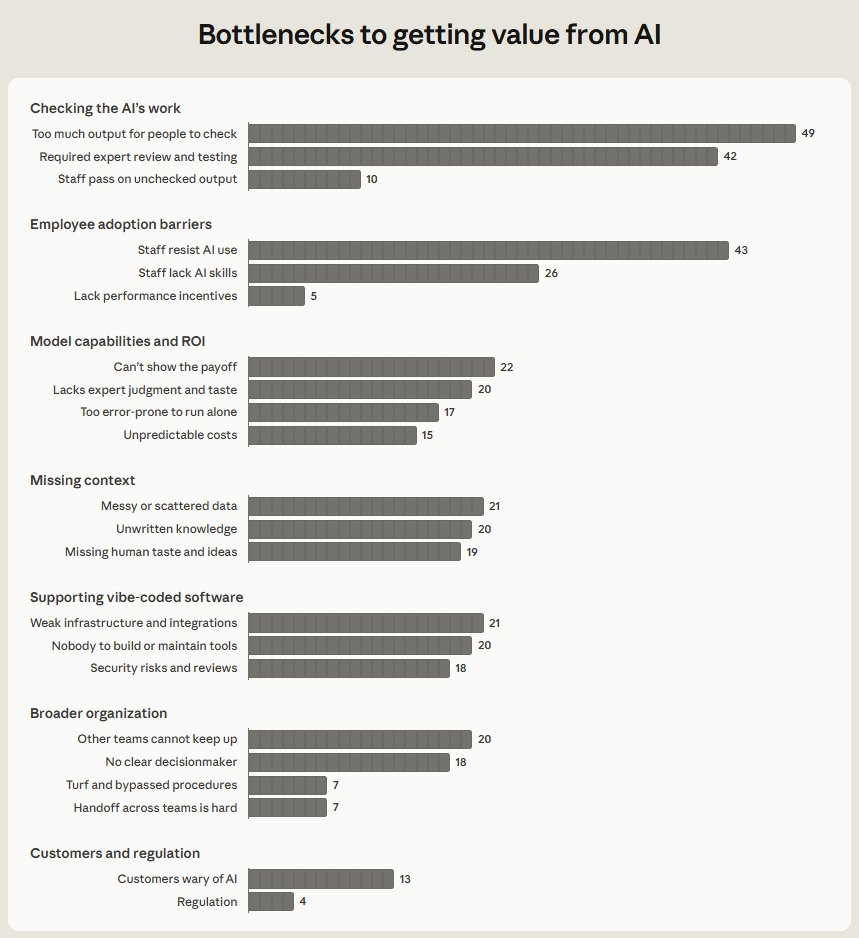
Employee pushback is the second most common hurdle, appearing in 43 mentions within the report. Workers expressed deep fears that building AI systems would eventually lead to their own replacement.
One employee told researchers, "If I'm open to this, I'm essentially building my own coffin," This anxiety has led to both open and quiet resistance. At one firm, human reviewers deliberately slowed down their work to maintain traditional timelines despite AI assistance.
The study also noted a "panopticon effect" where companies use AI to monitor staff more closely. Some firms now generate daily reports on hourly error rates and customer call scores. This surveillance, combined with top-down automation, has damaged trust in several workplaces.
One executive noted that some staff hide their efficiency gains to avoid more work. "They don't want you to know, because they want to use those 10 hours a week to go walk their dog," the official said.
Read More: Anthropic Lets Users Turn Claude Artifacts Into Desktop Apps
Beyond cultural issues, technical and security risks are rising as more employees experiment with tools. One data security chief warned that every single employee now is a developer which creates new risks every day. Many companies also struggle with "zombietrying to throw darts at a spinning dart board."
According to the official report, successful companies are now reshaping job roles to fit the technology. Some firms are moving staff toward strategic tasks that AI cannot handle, such as customer relationships. Others are investing in shared IT infrastructure so non-technical staff can access clean data.
Despite these shifts, two-thirds of the companies surveyed said they are already hiring fewer people because of AI integration.
A new Anthropic report titled Working with AI provides a reality check for those expecting immediate efficiency gains, noting that while models continue to improve, implementation often creates significant friction. Researchers conducted 66 in-person interviews across 58 U.S. Organizations, ranging from specialized AI startups to established firms in the medical, legal, manufacturing, finance, and construction sectors.
While the study examined nearly 300 real-world deployments, the authors clarify that the sample is not fully representative as every participant is an existing Anthropic customer.
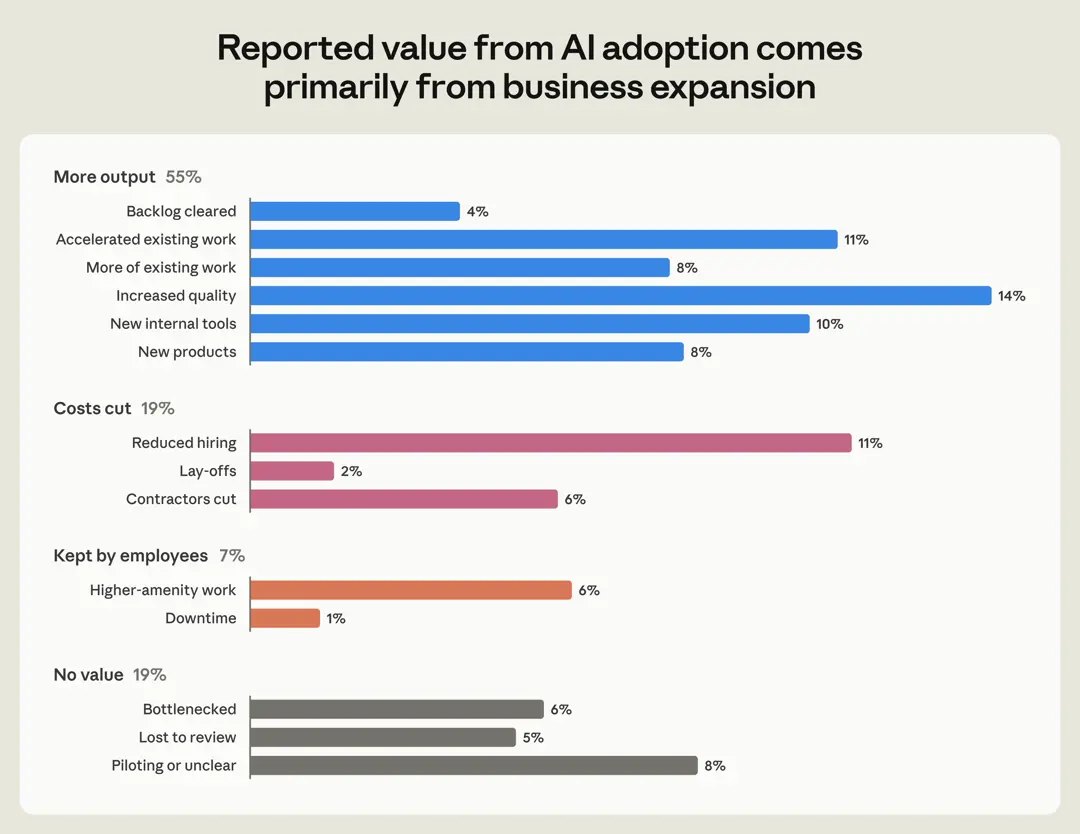
The findings indicate that 55 percent of the studied deployments resulted in higher quality or increased output. However, the financial impact varies widely; some tasks saw costs drop to as little as $30, while others reached $100. The transition has also altered internal dynamics, with 19 percent of mentions highlighting the need for new skill sets.
Only 8 percent of mentions focused on direct cost savings, while 6 percent addressed speed and 5 percent noted improved employee morale. Despite these hurdles, 40 percent of mentions in the qualitative data, which included insights from the Stanford Social Media Lab, centered on the evolving nature of work.
These findings were further detailed in a supplementary PDF accompanying the research.
What's Your Reaction?
 Like
3
 Dislike
 Love
 Funny
1
 Wow
1
 Sad
 Angry
1

Tech journalist and AI enthusiast who enjoys keeping up with the latest in hardware, processors, emerging AI tools, and software. I like digging into new technology, understanding how things actually work, and following the developments that could shape the way we use technology in the future.




















Comments (0)