
Trump Move On Beef Tariffs Symbolic, Comes Amid Record Imports In 2026
- President Trump confirmed a 90-day tariff reduction on beef imports, aiming to combat food inflation. This move is largely sy
- cattle herd since the 1950s. The U.S. cattle industry expressed strong disapproval, arguing it floods the market with subsidi
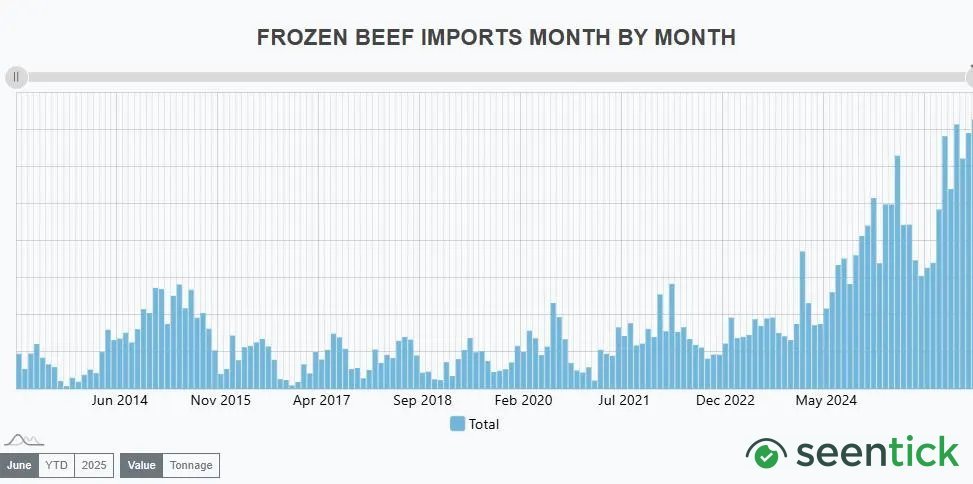
- Data shows fresh and frozen beef imports are at record values, with frozen beef potentially surpassing fresh for the first ti
President Trump confirmed a 90-day tariff reduction on beef imports, aiming to combat food inflation. This move is largely symbolic, as it impacts only a small fraction of beef consumption and is temporary. It also comes amidst record beef imports and the smallest U.S.
cattle herd since the 1950s. The U.S. cattle industry expressed strong disapproval, arguing it floods the market with subsidized beef instead of helping rebuild the domestic herd.


Key Analysis and Detailed Timeline
Data shows fresh and frozen beef imports are at record values, with frozen beef potentially surpassing fresh for the first time since 1989, driven President Trump confirmed Friday that he was lowering tariffs on beef imports for 90 days, a largely symbolic, even quixotic move that comes amid record 2026 shipments from Canada, Mexico, Australia, Brazil, Nicaragua, Argentina, New Zealand and a host of other countries.
Trump’s goal is to lower prices as Americans continue to cite inflation, and in particular food inflation, as one of the most seemingly intractable problems they face amid the war in Iran, which is affecting gasoline prices; the war in Ukraine, which is affecting fertilizer and food prices; and tariffs, which are affecting a host of other products, including cars.
What makes it largely symbolic and even quixotic are four factors: The move comes amid record imports of both fresh and frozen beef, almost two-thirds of the former coming from USMCA partners Mexico and Canada, and more than half of the latter coming from Australia and Brazil. It did not please the U.S. cattle industry, either.
Broader Impact and Sector Outlook
“While America’s cattle producers share the goal of keeping groceries affordable for consumers, flooding the market with government-subsidized, below-market beef is not the way to rebuild the American cattle herd,” said Colin Woodall, the group’s chief executive officer, as quoted in the Wall Street Journal. Through June, the most recent data available from the U.S.
Census Bureau, U.S. imports of fresh or chilled beef totaled $3.95 billion, a 30.66% increase over the first six months of 2025. Looking at all U.S.
Read More: AI Is Shoring Up Cognitive Errors Made By Mental Health Therapists
imports, the total has decreased 1.14% in that same time period. Because the Census Bureau does not release tonnage figures for land-based trade, it is unclear how much of that increase is related to price rather than volume. But when it comes to frozen beef, a slightly larger import market, the Census Bureau does release tonnage figures.
Both However, in recent months, the value continued to increase while the tonnage stalled, suggesting a price increase. The price increase through the first six months of the year was 29.96% – nearly matching the increase in fresh or chilled beef – to $4.5 billion while tonnage was up less than half that, 12.18%.
If the value of imported frozen beef continues to be worth more than the fresh or chilled beef category, it will be the first time it does so on an annual basis since at least 1989, according to the USDA.
The top three gateways for imported fresh or chilled beef are Port Laredo for Mexican beef, Sweet Grass, Montana for Canadian beef and PhilaPort for fresh beef from Australia. Each accounts for about 23% of the total.
The top port for frozen beef imports is PhilaPort, with just under 45% of the total this year The Port of Houston handles another 18.09% 85% Taken together, these numbers underscore the disconnect between the politics of tariff relief and the economics of the beef market.
Imports were already surging before Friday's announcement, driven The tariffs on Mexican, Canadian, Australian and Brazilian beef didn't only not create the issue but, it could be contended, helped keep in check. And a 90-day suspension is unlikely to meaningfully fix the problem. Ranchers, meanwhile, are left arguing that the move undercuts the very rebuilding of the U.S.
herd that would bring prices down for the longer term.
What's Your Reaction?
 Like
0
Like
0
 Dislike
0
Dislike
0
 Love
0
Love
0
 Funny
0
Funny
0
 Wow
0
Wow
0
 Sad
0
Sad
0
 Angry
0
Angry
0

SeenTick is a digital news platform bringing you the latest and most important stories from India and around the world. Explore news and updates across politics, business, technology, AI, gaming, health, sports, entertainment, science and more.












Comments (0)